
Tree Roots in Kissimmee Soil Grow Shallow and Wide
Roots need oxygen as much as water, and in Kissimmee the ground below a foot or two is often wet for much of the year. Our flat pine flatwoods soils are sandy and poorly drained, with a high water table. UF/IFAS describes trees on sites like these with few roots deeper than about 12 inches. Instead of going down, roots go out.
And they go farther than most people expect. UF/IFAS notes that roots commonly reach two to three times the distance from the trunk to the edge of the canopy. A tree with a 10-foot radius of branches can have roots 20 to 30 feet out or more. That is how an oak in the side yard ends up under the pool deck on the other side of the house.
How Tree Roots Damage Pool Decks in Kissimmee
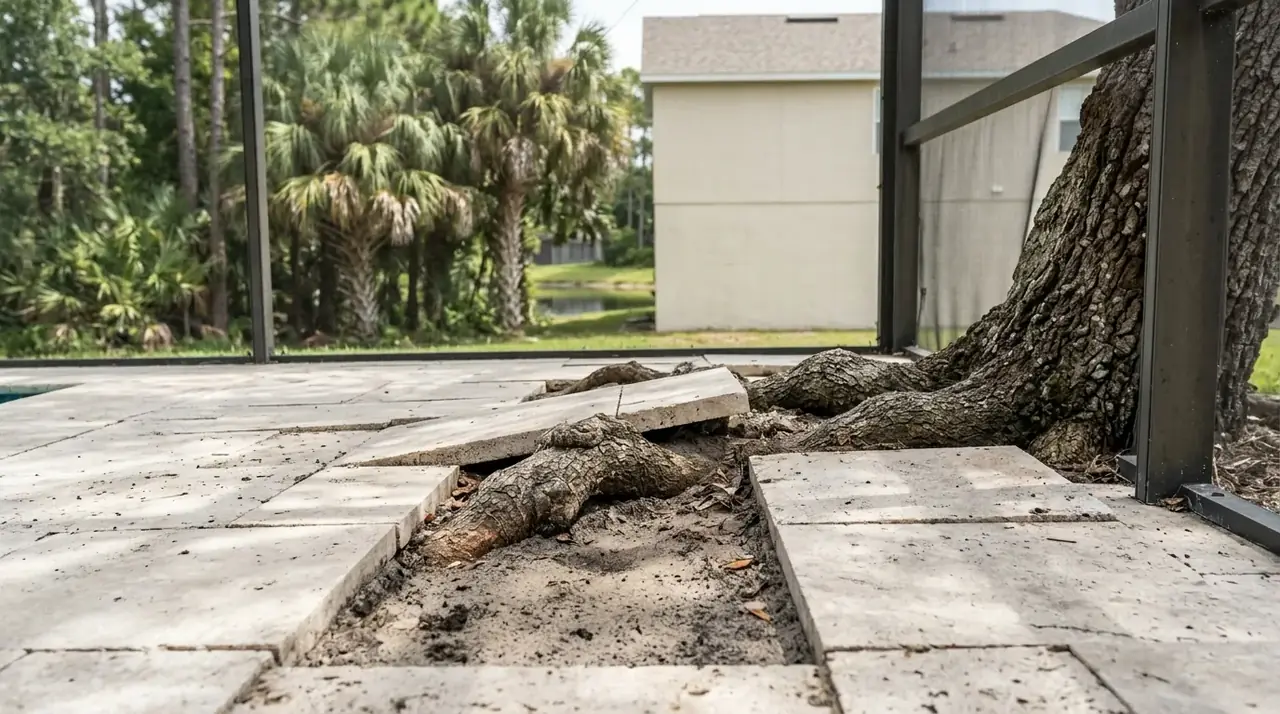
Roots grow where conditions are good, and the soil under a paver or concrete deck is often a nice spot. It stays moist, it is shaded, and water condenses on the underside of the slab. Roots grow along that layer and thicken every year, slowly pushing pavers up or cracking thin concrete. Leaky pool plumbing or irrigation can make a spot even more attractive.
Lifted pool-deck pavers are a trip hazard and a nuisance, and on rental homes they are a guest-safety issue. Our vacation rental tree care guide covers that side of it.
Tree Roots and Foundations: What We Can and Cannot Tell You
Roots near a foundation worry people more than anything, and it is worth being careful about what anyone claims. Slabs crack for many reasons, including settling, poor compaction and drainage. We can tell you where the roots are, how big they are and whether the tree is a good fit for its spot. We cannot tell you a root caused a structural crack. If you see cracks in the house itself, have a structural engineer or foundation professional look before you remove a tree on that assumption.
Signs Tree Roots Are Becoming a Problem
- Pavers or deck joints that rise a little more each year in a line pointing back toward a tree.
- Surface roots running across the lawn that the mower now hits.
- A sidewalk or driveway edge lifting near a mature oak.
- Slow drains or repeated clogs in a line that runs near a big tree, which a plumber should camera-inspect.
- Soil heaving or cracking along one side of a tree after heavy rain, which can be a stability warning rather than a hardscape issue.
Root Pruning Risks for Kissimmee Trees
Cutting the root under the pavers sounds like an easy fix. Sometimes it is. But UF/IFAS woody plant research is clear that root cutting gets more damaging with more cuts, bigger cuts and cuts closer to the trunk. It also notes that roots just one to three inches across can be major structural roots holding a tree upright.
Our soils make that worse. The same UF/IFAS guidance says root pruning and trenching close to the trunk cause more injury on shallow, compacted or poorly drained soils than on well-drained ones, and that you should stay farther from the trunk on shallow soils. Leaning trees, trees in poor health and old mature trees are all poor candidates. Put a shallow root plate in saturated summer ground, cut one side of it, and you have a tree that can tip in the next storm. Our look at what Hurricane Ian taught Osceola County about trees explains why soaked sand and shallow roots are such a bad mix.
Root Barriers for Pools and Driveways in Kissimmee
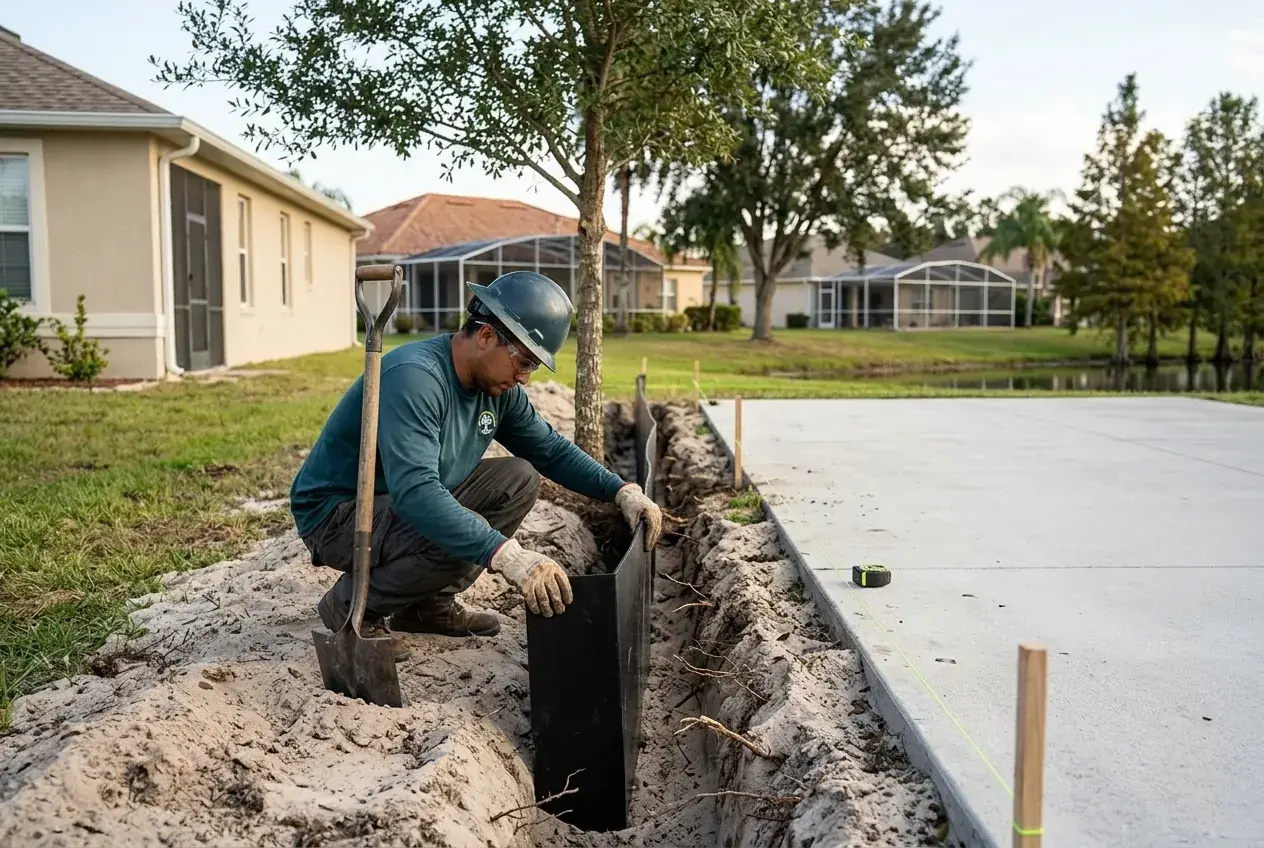
Root barriers are vertical panels set in a trench between a tree and whatever you want to protect. They work best when installed at planting time or during new construction, before big roots are in the way. UF/IFAS-affiliated guidance calls for installing them vertically and deeper than 12 inches.
They are not a permanent wall. UF/IFAS trench studies found that barriers tend to push roots deeper, but roots still grow under and around them, and barriers need periodic checks so roots do not grow over the top edge. On a high water table, roots cannot always go very deep, so they may come back up on the other side of the barrier. A barrier buys time and distance, which is often enough.
| Option | Best use |
|---|---|
| Root barrier at planting | New trees near pools, driveways, slabs or sidewalks |
| Selective root pruning | Small roots well away from the trunk on a healthy, upright tree |
| Rebuilding the deck around the root | Valuable trees where cutting would cost stability |
| Tree removal and stump grinding | Trees too close to the structure to keep safely |
| Replanting farther away | Long-term fix after a removal |
Protecting Tree Roots During Kissimmee Pool and Patio Projects
A lot of the root damage we see happens during construction, not years later. A new pool, a patio extension or an irrigation trench can sever a big share of a tree's roots on one side in a single afternoon. If you want to keep a mature tree through a project, plan for it before the excavator shows up:
- Mark off as much of the root zone as possible and keep trucks, machines and material piles out of it.
- Do not add fill dirt over existing roots. Burying roots under several inches of soil can starve them of oxygen, especially in wet ground.
- Ask your contractor to route trenches for plumbing, electric and irrigation away from the trunk side of the tree.
- Have large roots cut cleanly with a saw instead of torn by a backhoe if they must be cut.
- Water the tree during dry spells for the first year or two after the work.
If the project means cutting roots close to the trunk, it may be safer to remove the tree first than to leave a weakened one next to a brand-new pool. We would rather tell you that before construction than after a storm.
Trees to Keep Away From Pools and Slabs in Kissimmee
The right tree in the right spot avoids most of these problems. Here is how common local species stack up near hardscape:
- Live oak: one of the most wind-resistant trees in UF/IFAS research and worth keeping, but it grows into a huge tree with large surface roots. Give it serious room from pools and houses.
- Laurel and water oaks: fast-growing and common in older yards, but UF/IFAS puts them in its lowest wind resistance group. One with roots under a pool deck and decay at the base is often better removed than root-pruned.
- Ficus: UF/IFAS has documented a ficus with only shallow roots leaning over in a hurricane. Ficus can grow large surface roots and are a poor choice beside a pool.
- Camphor: listed as a Category I invasive by the Florida Invasive Species Council, and UF/IFAS does not recommend planting it in Central Florida. It is a removal candidate on its own merits.
- Palms: palm roots stay a fairly consistent thin size rather than thickening into big woody roots, which is one reason palms are popular around pools. Keep fruiting palms back so debris stays out of the water.
Tree Removal Near Pool Cages and Foundations
When a tree has to go, the job near a pool needs patience. Pieces get roped and lowered rather than dropped, and the stump often needs grinding close to the deck edge. Our tree removal crews handle that work regularly in neighborhoods like Hunters Creek and Meadow Woods, where older oaks sit close to pool homes. Then stump grinding takes care of the stump and the largest surface roots so you can repair the pavers. Before you remove a healthy tree, check our guide on tree removal permits in Kissimmee, since your HOA may require approval.