Service area · St. Cloud & South
Harmony FL Tree Trimming and Removal That Fits a Conservation Community
Harmony was built around Buck Lake, Cat Lake and large conservation lands east of St. Cloud on US-192. We prune and remove trees here with the community's HOA and wildlife guidelines in mind.
Harmony FL Tree Trimming in a Community Built Around Its Land
Harmony is an unincorporated master-planned community in Osceola County on the north side of US-192, east of St. Cloud. Residents began moving in around 2003. The community development district dates to 2000, and the Harmony Residential Owners Association was set up in 2002 with founding documents that address how people and wild animals share the land. Harmony also began a working relationship with the University of Florida's wildlife ecology program in 2001 and is certified as a green community by the Florida Green Building Coalition.
Two natural lakes anchor the place: Buck Lake at roughly 510 acres and Cat Lake at about 430. Large tracts around the neighborhoods are set aside as conservation land, with wetlands, pine flatwoods and oak hammocks left largely as they were. The Harmony Golf Preserve, a Johnny Miller design, threads through part of it. For us, all of that means tree work here is less about clearing and more about careful pruning, hazard removal and respect for the surrounding habitat.
Harmony Tree Stock: Oaks, Pines and Lake-Edge Cypress
Planted trees along Harmony's streets lean heavily on live oaks, with sabal palms, magnolias and crape myrtles in yards and parks. Beyond the back fences, the native woods are slash and longleaf pine, laurel and water oak, wax myrtle, and cypress near Buck Lake and Cat Lake. The ground is flat and sandy with a seasonal high water table, so roots stay shallow and wide.
Two problems come up repeatedly. First, street oaks planted in the early 2000s are now big enough to reach roofs, block streetlights and drop limbs on sidewalks, and many were never structurally pruned when young. Second, homes backing onto conservation land see pines and oaks from the preserve leaning toward their yards, and those trees may not be the homeowner's to touch.
Harmony Neighborhoods and Spots Where We Work
- Harmony Central - the original core near the town square, with the community's oldest planted street oaks now reaching second stories.
- Lakes of Harmony - homes near the water, where cypress, palms and a high water table shape what we recommend.
- Harmony West - newer phases with young trees that benefit most from early structural pruning.
- Ashley Park - townhomes and condos on tree-lined streets, where the association often controls the trees.
- Lakeshore Drive and Lakeshore Park - park-side homes with sabal palms and oaks near the splash pad and dog park.
- Homes along the Harmony Golf Preserve - fairway-side oaks and pines that need clearance without encroaching on the course.
Tree Removal in Harmony: When It Makes Sense
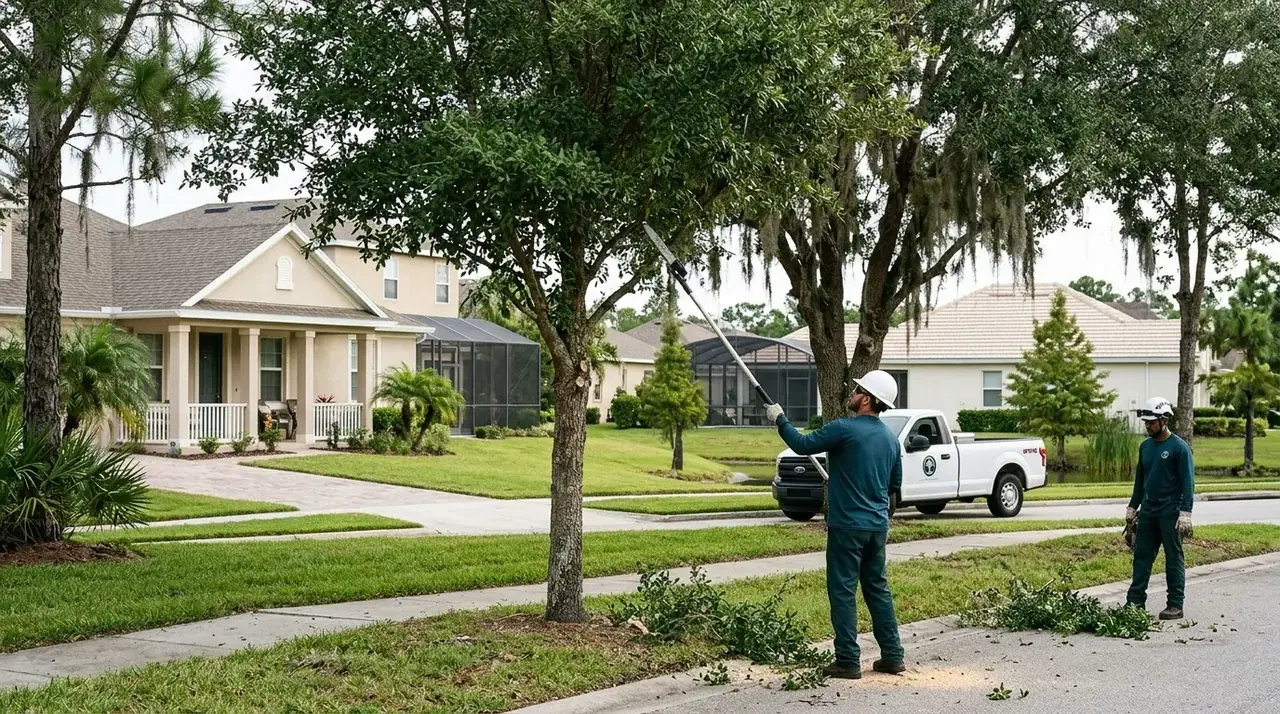
Most Harmony work is pruning rather than removal. We raise canopies off roofs and sidewalks, thin crowns so storm winds pass through, remove deadwood and clean up palms. Removal comes up when a laurel oak has decayed, a pine was struck by lightning, or a tree planted too close to a foundation is lifting the slab or crowding a pool cage. Our post on tree roots, pool decks and foundations explains when roots are a real threat and when they are not.
Timing matters here more than in most neighborhoods. Harmony's conservation lands hold nesting birds and other wildlife, and federal and state rules protect active nests of many species. We look for nests before we cut, and if one is active, we talk with you about waiting.
Harmony HOA and Osceola County Tree Rules
Harmony sits in unincorporated Osceola County, so the county's Land Development Code, Article 4.8, sets the baseline for tree removal and clearing. The bigger factor for most homeowners is the Harmony Residential Owners Association. Exterior changes, including removing or replacing yard trees, typically go through the association's review process, and trees in common areas and conservation tracts belong to the community or district rather than the homeowner. We could not confirm the current written thresholds, so we check the association's requirements on every estimate and tell you what to submit.
Florida Statute 163.045 still applies to a homeowner's own lot. When an ISA certified arborist or Florida licensed landscape architect documents that a residential tree poses an unacceptable risk, the county cannot demand a permit, fee or replacement. Private HOA covenants are a separate question, which is why we look at both.
Harmony Electric Service and Line Clearance
Electric service in this part of eastern Osceola County may come from OUC or Duke Energy depending on the address, so check your bill before calling about line clearance. The utility handles trees touching its lines. We handle the rest once it is safe.
Harmony Tree Trimming and Removal Prices
Canopy raising and thinning on a typical Harmony street oak usually runs $200 to $950 depending on size and how much needs to come out. Palm cleanup is commonly $90 to $300 a palm. Removing a medium laurel oak or pine in the 30 to 60 foot range generally falls between $900 and $1,900, and a split or weak fork on a valued oak can sometimes be cabled for $350 to $1,200 instead of removed. Every quote is flat and written, and HOA paperwork does not change our price.
Harmony FL Tree Services We Provide
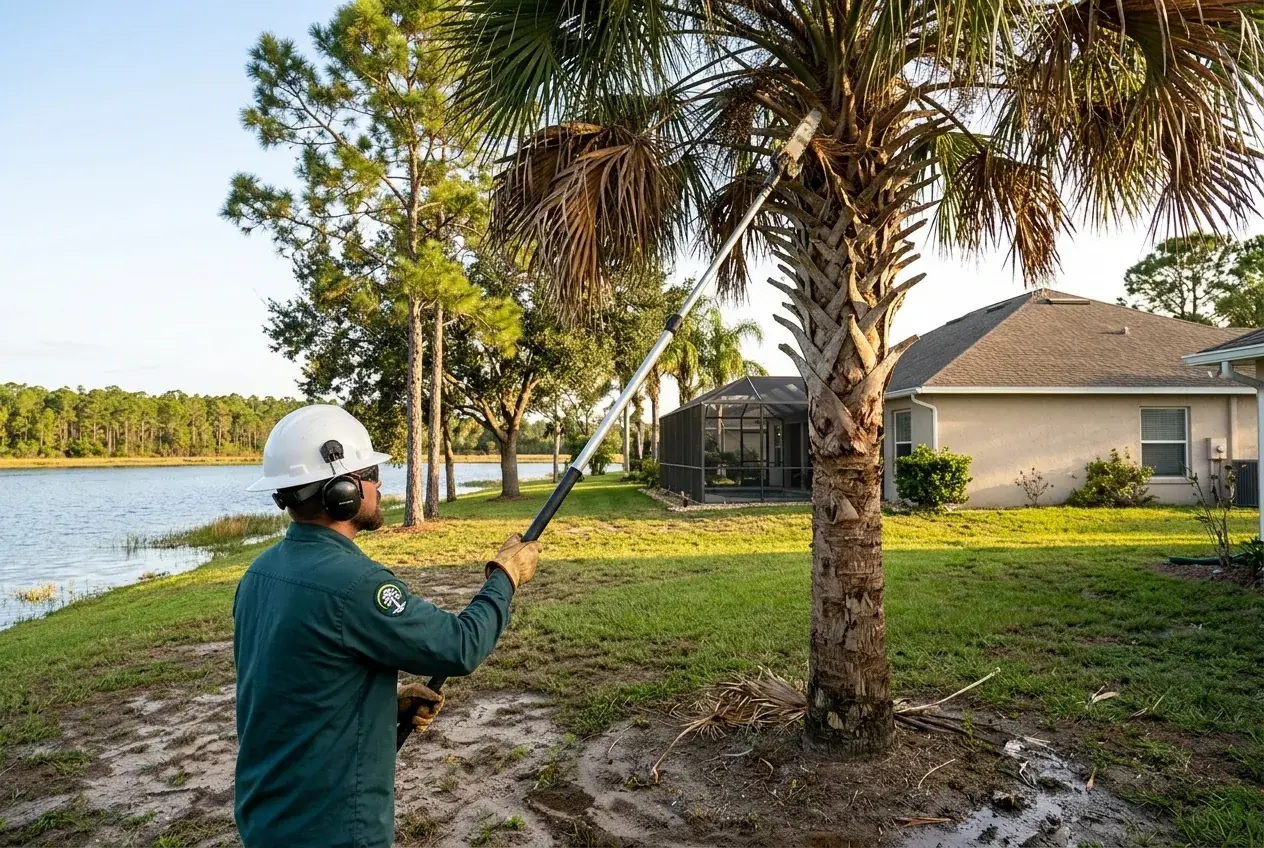
The core of our Harmony work is tree trimming and pruning on maturing street and yard oaks. When a tree is too far gone we do careful tree removal with full cleanup. Tree cabling and bracing can save a split oak the HOA would rather keep, and palm tree trimming keeps sabals tidy. Before storm season, hurricane tree prep takes weak limbs out before the wind does.
Tree Service in Areas Near Harmony
Heading back west on US-192, our St. Cloud tree service crews work the city on East Lake Toho. North of town, Narcoossee covers the CR 15 corridor and its newer subdivisions.
Questions
Questions About Tree Work in Harmony
In most cases, plan on it. The Harmony Residential Owners Association reviews exterior changes, and tree removal or replacement on a lot typically falls into that category. Requirements can change, so we check the association's current rules on every estimate and help you prepare photos or a short assessment for the application.
Generally no. Conservation tracts and common areas belong to the community or its district, not to the homeowner, even when trees lean toward your yard. If a tree on that land threatens your house or fence, contact the association or district first. We can document the hazard with photos and notes to support your request.
Late fall through winter is ideal. Growth is slow, more nesting season is behind us, and you get the tree in shape before hurricane season. Dead or hazardous limbs can come off any time. If we find an active nest during the season, we will usually recommend waiting unless the tree is an immediate danger.
Many planted in the early 2000s are now large enough to reach roofs, block streetlights and drop limbs over sidewalks. That does not mean they need removal. Raising the canopy and thinning the crown usually fixes clearance problems and makes the tree stronger in storms. Street trees in common areas are typically the association's responsibility, so check before trimming.
Native species fit Harmony's conservation focus and the sandy, seasonally wet soil. Live oak, Southern magnolia, sabal palm, dahoon holly and bald cypress for wetter spots all do well. Keep large trees well back from the house and pool cage. The HOA may have an approved plant list, so check before buying.
Yes. We look for active bird nests and wildlife use before cutting, especially near the lakes and preserve. Many nesting birds are protected by state and federal law. If we find an active nest, we talk through options, which may mean waiting a few weeks. We also keep debris and equipment off the conservation side of your property line.
Often it can. If the wood is sound and the split is caught early, cabling and bracing can hold the two leads together and keep the tree standing for years. It is usually cheaper than removal and keeps the shade the community values. If decay has already set in at the crack, removal may be the safer call.
Trees on your own lot are your responsibility, and we can clear them through our 24/7 line. Trees in common areas, parks and conservation land are handled by the association or the district. Fallen trees on lines go to the utility first. We photograph damage on your lot for insurance before we start cutting.
Nearby
Other Osceola-Area Neighborhoods Near Harmony
Need a tree crew in Harmony?
We come out, look at the tree and put a fixed price in writing. Harmony is on our regular route.
Mon–Sat 7:00am–7:00pm (24/7 emergency line for storm work) · Licensed & insured