
Kissimmee · Osceola County, FL
Land Clearing in Kissimmee and Osceola County Lots
We clear homesites, fence lines, pastures and overgrown back acreage across Osceola County, from saw palmetto flatwoods to Brazilian pepper thickets. Before a machine moves, we check permits, wetlands and gopher tortoise burrows with you.
Land Clearing Kissimmee Property Owners Can Plan Around
East and south of Kissimmee, a lot of the land still looks the way it did when cattle ran across it: flat pine flatwoods with slash and longleaf pine overhead, thick saw palmetto below, and wet swales and cypress heads scattered through it. Clearing that ground for a homesite, a driveway, a fence line or a pole barn takes a different approach than clearing hilly scrub. The ground is soft for much of the year, the water table is high, and there are often wetlands and protected wildlife mixed into the parcel.
Our land clearing work ranges from cleaning up an overgrown back half-acre in St. Cloud to opening a homesite on several acres out toward Holopaw or Narcoossee. On most jobs, the goal is not to scrape everything bare. It is to remove what is in the way, keep the trees worth keeping, and leave a site that drains and can be built on or used.
Ranch heritage still shapes a lot of this land. Old pasture edges are often lined with sabal palms, barbed wire grown into tree trunks, and decades of brush pushed into piles. We expect buried fence wire, old culverts and the occasional abandoned well cover on rural parcels, and we walk the ground slowly before any machine goes in. Those surprises are cheap to find on foot and expensive to find with a mulcher head.
Land Clearing in Kissimmee, FL: What It Can Include
- Underbrushing: removing saw palmetto, wax myrtle, vines and small trees while leaving the larger pines and oaks standing
- Full clearing of a building pad, driveway path or septic area, including trees and stumps
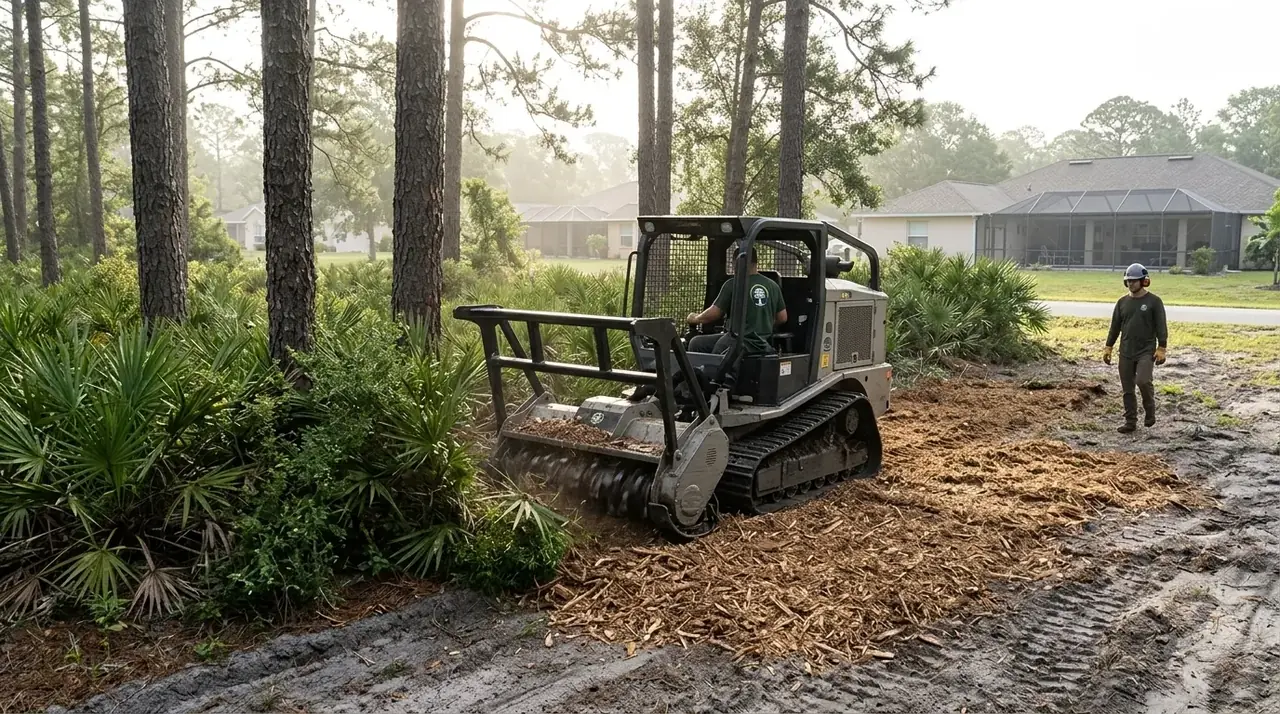
- Forestry mulching that grinds brush and small trees in place into a layer of mulch
- Tree removal and haul-off of logs and debris when a clean, mulch-free surface is needed
- Stump grinding or stump removal across the cleared area
- Removal of invasive species such as Brazilian pepper, camphor and air potato vines
- Fence line and pasture edge clearing on ranch and rural parcels
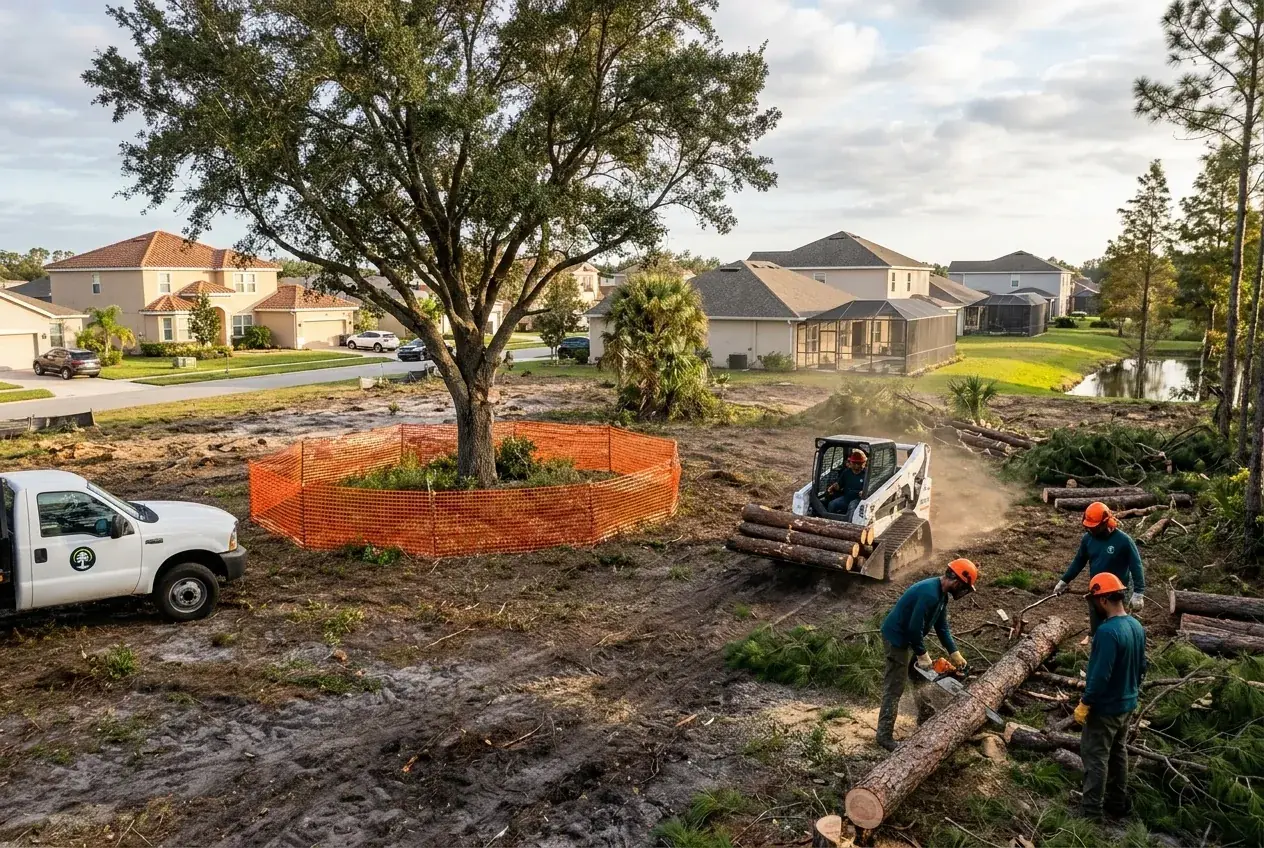
We walk the property with you first and mark which trees stay. Large live oaks, healthy longleaf pines and trees along property lines often add value to a homesite, and once they are gone they are gone. Trees that stay get protective barriers at the dripline so equipment does not compact or tear their roots.
Saw palmetto deserves a word of its own. It grows from thick, creeping trunks that run along or just under the surface, and it regrows from those trunks if it is only mowed. Mulching knocks it down well, but palmetto that will be under a building pad or lawn usually needs its root crowns removed or ground out so it does not come back through the sod. Cogongrass, another flatwoods invader, spreads when mowed or disked, so patches of it need treatment by a licensed applicator before or after clearing.
Land Clearing Cost Per Acre Around Osceola County
Light clearing of brush and small trees on dry, accessible ground usually costs somewhere between $2,000 and $7,000 or more per acre. Dense palmetto, big trees, wet ground and haul-off push that higher. Small jobs, like a single homesite pad or a fence line, are often priced by the job instead of by the acre.
A few things can surprise owners on price. Haul-off and dump fees on a big parcel add up quickly, mats are needed on wet ground to keep equipment from sinking, and surveys or permit preparation are separate from our work. Our proposal spells out what is included and what is not, so you are comparing apples to apples if you collect more than one bid.
| Job | Typical range | What moves the price |
|---|---|---|
| Light underbrushing, dry ground | $2,000–$3,500 per acre | Density of palmetto and how many trees are saved |
| Forestry mulching, moderate brush | $3,000–$5,500 per acre | Brush height and thickness, and stem size |
| Full clearing with trees and stumps | $4,500–$7,000+ per acre | Number of large trees and stump grinding |
| Dense or wet ground, haul-off | Above $7,000 per acre | Soft soil, mats, trucking distance and dumping |
| Homesite pad or driveway path | Priced per job | Size of the area and the trees in it |
Land Clearing Permits in Osceola County: Wetlands and Wildlife
This is the part people skip, and it is the part that causes the most trouble later. Osceola County's land development code generally requires a development permit, land clearing authorization or tree removal permit before site activity on a parcel, with limited exemptions. The county's land clearing process typically calls for a site plan showing the clearing limits, silt fence along borders and wetlands, and tree barriers at the dripline of trees that will remain. The City of Kissimmee and the City of St. Cloud have their own rules within city limits. Florida Statute 163.045 lets owners remove a documented hazard tree on residential property without a local permit, but it does not cover clearing for development. We check the current requirements for your parcel on every estimate, and our tree permit guide covers the basics.
Wetlands and water management districts
Low areas, cypress domes and wet prairies are common on Osceola County land, and work in wetlands or surface waters can require an Environmental Resource Permit from the regional water management district. Much of Osceola County, including the Kissimmee area and the chain of lakes, falls under the South Florida Water Management District, while parts of eastern Osceola drain toward the St. Johns River and fall under the St. Johns River Water Management District. Federal wetland rules may also apply. We do not clear inside wetland lines without the paperwork in place, and if your parcel has wetland areas, a survey or environmental consultant may be needed to map them.
Gopher tortoises
Gopher tortoises are a protected species in Florida, and their burrows are common in the sandy, well-drained parts of flatwoods parcels. The Florida Fish and Wildlife Conservation Commission requires a permit before clearing or development activity within 25 feet of a potentially occupied burrow, and an FWC-authorized gopher tortoise agent has to survey the site and handle any relocation. We look for burrows during the walk-through, and if any are near the work area, we plan around them or wait until the permit and relocation are complete.
Land Clearing Alternatives When a Full Clear Is Too Much
Many owners call for land clearing when what they actually want is a usable, safer property, not a bare one. Selective underbrushing often accomplishes that: palmetto and vines come out, the big pines stay, and the land looks open and park-like. It is also lighter on the soil, which matters on sandy ground that erodes once its cover is gone. For a few dead pines or a crowded backyard, our standard tree removal and stump grinding services are usually a better fit than bringing in a mulcher.
Timing is worth thinking about too. In the summer wet season, low parts of a parcel can hold standing water for weeks, and running heavy equipment across saturated ground ruts it badly. Drier months in winter and spring are usually the best window for clearing flatwoods sites, especially anywhere near a pond or ditch.
Land Clearing Near Narcoossee, St. Cloud and Poinciana
A typical project starts with a site walk, a written proposal, and a permit and wildlife check. Small jobs like fence lines and homesite pads can usually be scheduled within a couple of weeks and finished in one to three days. Multi-acre jobs depend on permits, surveys and weather. We clear land throughout Narcoossee and St. Cloud, on the larger lots of Poinciana, around Harmony, and on rural parcels across the county. Tell us about your property and what you plan to do with it through the quote request, and include the parcel ID if you have it.
Questions
Land Clearing FAQ for Kissimmee Property Owners
Light clearing of brush and small trees on dry, accessible ground usually costs between $2,000 and $7,000 or more per acre. Dense saw palmetto, large trees, wet ground, stump grinding and haul-off push the price higher. Smaller jobs such as a homesite pad or fence line are often priced by the job. We give a written proposal after walking the property.
In most cases, yes. Osceola County's land development code generally requires a development permit, land clearing authorization or tree removal permit before clearing, with limited exemptions, and the process can include site plans, silt fence and tree protection. Properties inside Kissimmee or St. Cloud follow city rules instead. We check requirements for your parcel during the estimate and tell you what is needed.
Forestry mulching uses a machine with a rotating drum that grinds standing brush, saw palmetto and small trees into mulch in place. The mulch stays on the ground as a protective layer that holds sandy soil and slowly breaks down. It is usually faster and cheaper than cutting and hauling, and it disturbs the soil less. It is not ideal for areas that need bare ground for a slab or fill.
Yes. That is called underbrushing or selective clearing, and it is one of the most common requests on flatwoods properties around Kissimmee. We remove saw palmetto, vines and small trees while keeping healthy slash pines, longleaf pines and oaks. The result opens up the property, reduces fuel for wildfire, and keeps the shade and value of the large trees.
Gopher tortoises and their burrows are protected in Florida. FWC requires a permit before clearing or development activity within 25 feet of a potentially occupied burrow, and an FWC-authorized agent must survey the site and handle any relocation. If burrows are near the work area, we either keep equipment at least 25 feet away or wait until permitting and relocation are complete.
We can clear the upland parts of a parcel, but work inside wetlands or surface waters can require an Environmental Resource Permit from the water management district, and sometimes federal approval. Most of the Kissimmee area falls under the South Florida Water Management District, while parts of eastern Osceola are under the St. Johns River district. If wetlands are present, the boundaries usually need to be mapped first.
It depends on what comes next. Mulching is cheaper and protects the soil, which makes it a good choice for pasture edges, trails and areas you want to keep natural. Hauling away logs and debris costs more but leaves clean ground for fill, sod, a driveway or a foundation. Many projects combine the two, mulching the edges and removing everything from the building area.
The drier months, usually from late fall through spring, are the best window for most flatwoods sites. During the summer rainy season, low areas can hold standing water and the sandy ground gets soft enough that heavy equipment leaves deep ruts. Clearing in dry weather is easier on the land and often faster, which can lower the cost.
Yes. Brazilian pepper is one of the most common invasive plants on Osceola County properties, and it forms dense thickets along ditches and fence lines. We cut and mulch or haul it, and grind stumps where needed. It resprouts strongly from stumps and roots, so a follow-up herbicide treatment by a licensed applicator is usually needed to keep it from coming back.
Yes. We clear homesites, driveways and septic areas on parcels around Narcoossee, St. Cloud and the rural parts of Osceola County. We work from your site plan or survey, protect trees you want to keep, and coordinate with your builder on timing. If permits are required, the clearing schedule follows their approval.
Related
More Tree Services Around Kissimmee
Clearing a lot in Osceola?
Walk the property with us and get a per-acre price with every item spelled out.
Mon–Sat 7:00am–7:00pm (24/7 emergency line for storm work) · Licensed & insured