
Kissimmee · Osceola County, FL
Tree Cabling and Bracing in Kissimmee for Split and Weak Oaks
When a valued oak has a weak fork or a crack between two big stems, cables and steel rods can sometimes buy it many more years. We tell you honestly whether support hardware makes sense, or whether the tree is past saving.
Tree Cabling Kissimmee Homeowners Use to Keep a Good Oak
Some trees are worth fighting for. A big live oak that shades the whole west side of the house, a laurel oak that frames the front yard, or a magnolia planted decades ago can be hard to replace in a lifetime. If one of them has a structural flaw, removal is not the only option. Cabling and bracing add support where the tree is weak, spreading load and limiting how far stems can pull apart in wind.
The typical candidate in Kissimmee is an oak with two or three large trunks rising from one point, called codominant stems. Where those stems meet, bark often gets pinched inside the union instead of forming a strong ridge of wood, and that included bark is a classic failure point. In a summer thunderstorm or hurricane, those stems flex in different directions and the union can split. A crack running down from the fork, or a seam that weeps sap, is a sign the process has started.
You can spot many of these problems from the ground. Look for a narrow V-shaped fork where two trunks meet, a dark vertical seam below that fork, bark that bulges outward on either side of the union, or one stem that moves noticeably more than the other in wind. Long horizontal limbs on old live oaks that have started to sag toward a roof are another common reason people call. None of those signs means the tree must come down, but each one deserves a closer look before the next storm season.
How Tree Cabling and Bracing in Kissimmee, FL Works
- An assessment of the whole tree first, including the root zone, trunk base and any decay, before hardware is discussed
- Steel cables installed high in the canopy between stems or limbs, usually about two-thirds of the way up from the weak union
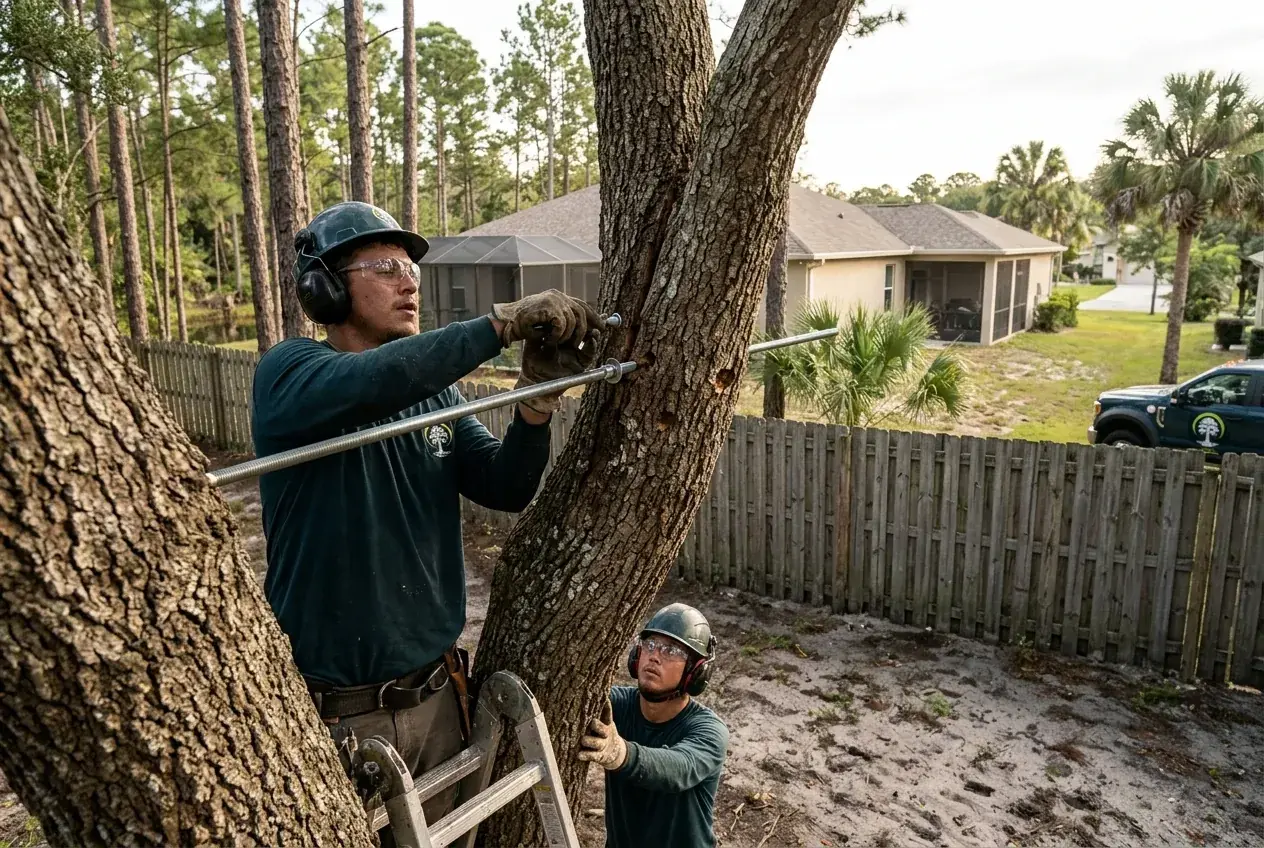
- Threaded steel rods bolted through split or cracked unions to hold the wood together
- Light reduction pruning to take weight off the ends of the limbs the hardware is supporting
- Hardware sized for the stem diameter and installed to the ANSI A300 support systems standard
- A written record of what was installed and where, so future inspections know what to look at
Cables do not hold stems rigid. They let the tree move in normal wind and only take load when the stems start to spread too far, which is what protects the union in a storm. Brace rods are different: they go through the wood itself and keep a crack from opening. Many trees get both, a rod low at the split and a cable higher up to keep the stems from levering it apart.
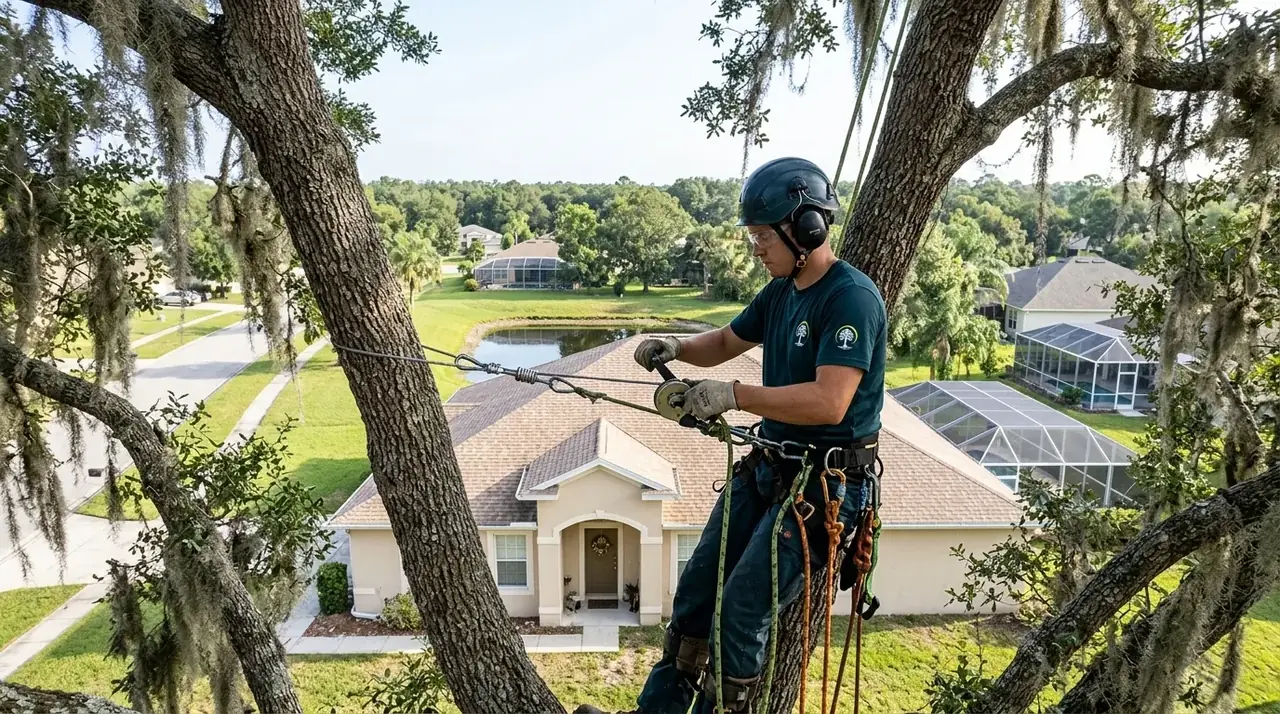
On install day, a climber works up into the canopy and sets anchor points in sound wood on each stem, then runs and tensions the cable between them. Rods are drilled and bolted from the ground or a ladder when the split is low. Debris is limited to whatever pruning we do alongside the hardware, and that is chipped and hauled off before we leave. Nothing is wrapped around the trunk or limbs, since girdling hardware can strangle a tree as it grows.
Tree Bracing Cost in Kissimmee and What Changes It
Most cabling and bracing jobs we do run between $350 and $1,200 per tree. The number depends on how many cables and rods the tree needs, how high the climber has to work, and whether the tree also needs pruning to reduce the load.
It helps to compare that against the alternative. Removing a large mature oak from a backyard in Kissimmee often lands well above the cost of supporting it, and you lose the shade and value the tree provides. When a tree is a good candidate, support hardware plus a light reduction is usually the more economical path. When it is not a good candidate, we will say so, even though it means a smaller ticket for us today.
| Job | Typical range | What moves the price |
|---|---|---|
| Single cable between two stems | $350–$550 | Height of the install and stem diameter |
| Two or three cables in one canopy | $550–$900 | Number of stems and how the cables are laid out |
| Brace rod through a split union | $400–$750 | Length of the crack and number of rods |
| Cabling, bracing and reduction pruning | $800–$1,200 | Canopy size and amount of weight being taken off |
| Annual hardware inspection | Often bundled with pruning | Whether the tree needs other work the same visit |
Tree Cabling and Bracing for Osceola County Soils and Storms
Support hardware addresses what happens above ground. It does nothing for a tree whose roots are giving way, and that matters here more than in many places. Around Kissimmee, the flat, sandy soil and high water table mean many trees root shallowly, and saturated ground after weeks of rain or a slow-moving hurricane is when whole trees tip over. When Ian dropped over a foot of rain on parts of Osceola County in 2022, many trees came down roots and all, with nothing wrong in their canopies. Before we recommend cabling, we look hard at the root plate, the soil, and any signs of recent movement. Our article on lessons from Hurricane Ian digs into this.
Species matters too. Live oaks with good roots and one flawed union are often excellent candidates. Laurel and water oaks can be cabled, but they decay more readily, so we check carefully for hollow sections and fungal conks before we drill anything into them. Pines and palms are not cabled; their structure does not lend itself to it. Heavy Spanish moss loads add weight in a storm, though moss alone is not a reason to cable a tree, as we explain in our Spanish moss article.
Trees over homes, pools and lanais
Many cabling calls involve a limb or stem that leans toward a roof or a screened pool cage. Supporting it can be a reasonable way to keep shade while lowering risk, but we weigh what it would hit. If a failure would land on a bedroom or a lanai where people sit, we may recommend reducing or removing that stem instead of trusting hardware to hold it.
Vacation homes raise the stakes a little, since guests spend their days on the pool deck under whatever trees the yard has. For rental owners we usually lean toward reduction pruning over hardware on any stem that hangs directly above the pool or lanai, and we send photos of the installed cables so the owner and the management company both have a record.
Tree Cabling in Kissimmee: When It Is the Wrong Answer
We turn down cabling jobs fairly often. A tree with major decay in the trunk, a cavity at the base, a large dead section, or a root plate that is lifting needs a different plan, and hardware would just give false confidence. In those cases, honest options are removing the tree or reducing the weak part through structural pruning. Young trees with a developing fork are another case where pruning beats hardware: removing or shortening one stem early avoids the problem altogether.
Ahead of hurricane season, cabling fits neatly into a broader property check. Our hurricane tree prep visit looks at every tree on the lot and flags the ones that would benefit from support, reduction or removal.
Tree Cabling Near Downtown Kissimmee, St. Cloud and Beyond
Most installs take two to four hours, depending on the number of cables and rods and whether pruning is part of the job. After installation, the hardware should be inspected once a year and after any major storm, since cables can loosen or wear and trees grow around hardware over time. We note what we installed so every inspection checks the same points. We install support systems on mature trees around Downtown Kissimmee, the older neighborhoods of St. Cloud, larger properties out toward Narcoossee, and the established streets of Buenaventura Lakes. Start with a free assessment through our request form.
Questions
Tree Cabling & Bracing FAQ for Kissimmee Property Owners
Tree cabling is the installation of flexible steel cables high in a tree's canopy, connecting stems or limbs that have a weak attachment. The cable lets the tree move normally in light wind but limits how far the stems can spread apart in strong gusts. That reduces stress on the weak union below. It is a support measure used to extend the safe life of a tree that is otherwise healthy.
Cabling uses flexible cables up in the canopy to limit movement between stems. Bracing uses rigid threaded steel rods installed through the wood, usually at or near a split or weak union, to hold the stems together. Cables manage movement; rods hold a crack closed. Many trees with split forks get both, with a rod low at the union and a cable higher up.
Most cabling and bracing jobs cost $350 to $1,200 per tree. A single cable between two stems is at the lower end. Multiple cables, brace rods through a crack, and reduction pruning to take weight off the supported limbs push the price higher. We give a written price after assessing the whole tree, including the roots and trunk.
No. Cabling and bracing reduce the chance of a weak union failing, but no hardware can make a tree storm-proof. In Osceola County, many trees fail at the roots in saturated soil, and cables do nothing for root problems. That is why we assess the root plate and soil before recommending hardware, and why we are cautious about cabling trees that could hit an occupied part of the house.
Any hole is a wound, but a properly sized rod in a healthy tree causes limited damage, and the tree grows wood around the hardware over time. The risk of leaving a split union unsupported is usually far greater than the effect of a brace rod. We avoid drilling into decayed wood and pick hardware sized for the stem, following industry installation standards.
Steel cable systems can stay in service for many years, but they are not install-and-forget. Trees grow, hardware can loosen or wear, and storms test every connection. We recommend inspecting cables and rods at least once a year and after any strong storm. Sometimes cables need to be adjusted higher as the tree grows, or replaced if they show wear.
Sometimes. If a crack at a fork is recent, the wood around it is sound, and the roots are healthy, a brace rod and cable combination can hold it together and slow further splitting. If the split runs deep into the main trunk, the wood is decaying, or the stems have already separated widely, removal is usually the safer choice. We make that call after looking closely at the damage.
The best candidates are healthy, valuable shade trees with one or two weak points, often live oaks or southern magnolias with codominant stems. Laurel and water oaks can be cabled when they are sound, but we check them carefully for hidden decay. Pines and palms are not cabled. Trees with major rot, dead sections or failing roots are not good candidates.
Cabling does not remove the tree, so many associations do not require approval, but rules vary from one community to the next. Some HOAs want to know about any work on trees visible from the street. We recommend checking your association's guidelines, and we can provide a short description and photos of the planned work if a form is required.
Cabling can support a limb or stem that leans toward the house when its union is the weak point, but a lean caused by root problems is different and cannot be fixed with cables. We look at where any failure would land, how the roots and soil look, and how much the lean has changed. Sometimes reducing or removing that one stem is the better choice.
Related
More Tree Services Around Kissimmee
Save the oak, if it can be saved
We will tell you straight whether cabling is worth it or removal is safer.
Mon–Sat 7:00am–7:00pm (24/7 emergency line for storm work) · Licensed & insured