
Service area · St. Cloud & South
St. Cloud Tree Service From East Lake Toho to Canoe Creek
St. Cloud grew up on the south shore of East Lake Tohopekaliga, and its older streets still carry big oaks planted generations ago. We remove, trim and storm-proof trees across the city, from the lakefront to the newer subdivisions off Canoe Creek Road.
St. Cloud Tree Service on the Shore of East Lake Toho
St. Cloud sits on the southern shore of East Lake Tohopekaliga, a nearly round lake of about 12,000 acres in eastern Osceola County. The city began in 1909 as a retirement colony for Union Army veterans, which is where the nickname Friendly Soldier City comes from. Many north-south avenues carry state names, and the historic downtown runs along New York Avenue. US-192 shares its route with US-441 and becomes 13th Street as it passes through town.
That history shows up in the trees. The older grid near downtown has live oaks and laurel oaks that are 60 to 90 years old, many with Spanish moss and long horizontal limbs over streets and roofs. Push south and east toward Canoe Creek Road and Nolte Road and the lots get newer, with smaller planted trees and remnant pines left by the builders.
Tree Removal in St. Cloud, FL and the Lakefront Water Table
St. Cloud is flat, and the closer you get to the lake, the higher the water table. Sandy soil holds water for weeks in a wet summer. Hurricane Ian in 2022 made that clear: 10 to 16 inches of rain fell across the area, East Lake Toho rose for days after the storm passed, and the city asked residents in more than a dozen areas to evacuate voluntarily. Blackberry Creek was among the neighborhoods that flooded.
Standing water does slow damage. Roots in saturated ground run short of oxygen, and over the following year or two we see oaks thin out, drop limbs and develop decay at the base. If your yard sat underwater in 2022 and a big tree has been losing leaves since, it deserves a closer look. Our post on what Hurricane Ian taught Osceola County about trees goes into the signs.
Near the lake you will also find bald cypress, red maple and sabal palms, which handle wet feet far better than laurel oaks. Laurel oak is the tree we remove most in St. Cloud. It grows fast, matures early and often hollows out by 50 or 60 years.
St. Cloud Neighborhoods We Work In
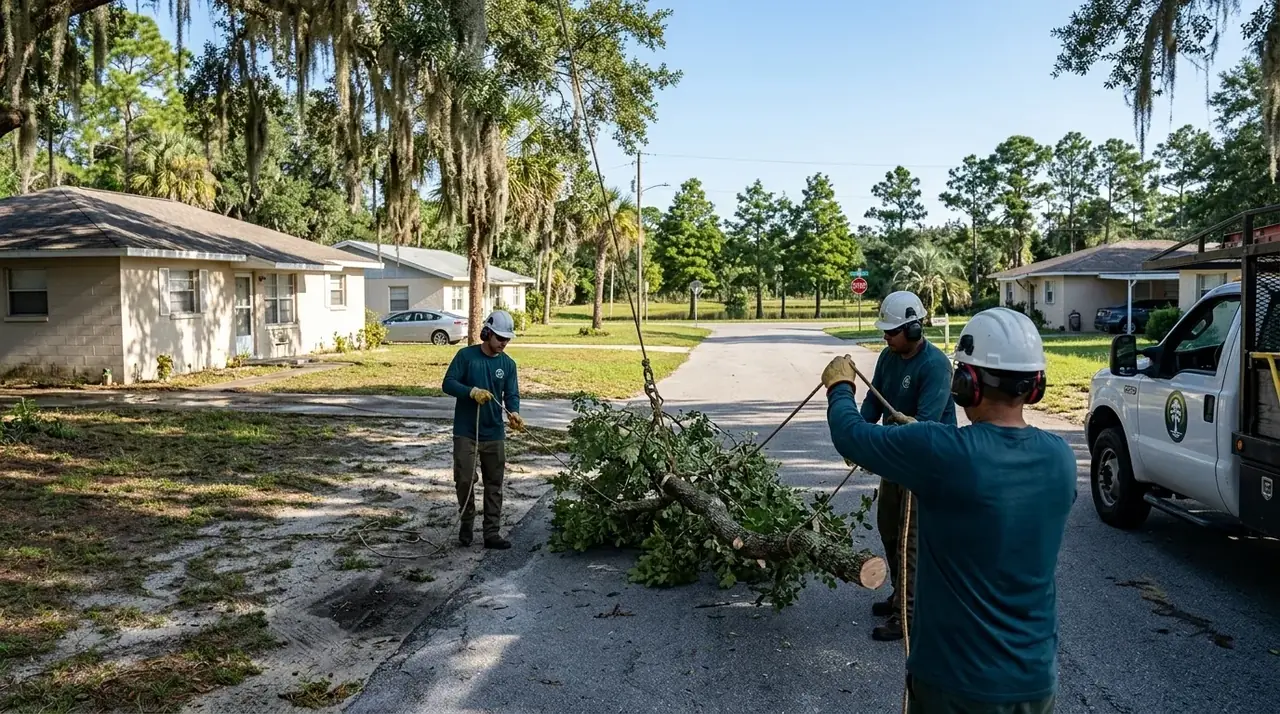
- Downtown and the historic grid - big old oaks over narrow streets, overhead lines and alleys, where we often rope down limbs piece by piece.
- Lakefront Park and Lakeshore Boulevard area - homes near the marina and the lakefront path, with cypress, palms and a very high water table.
- Blackberry Creek - a neighborhood that flooded during Ian, where water-stressed oaks are worth checking.
- Canoe Creek Road corridor - Canoe Creek Lakes, Canoe Creek Estates and nearby subdivisions with 1990s and 2000s oaks now large enough to reach roofs.
- Stevens Plantation and Indian Lakes - south-side neighborhoods with pond-edge trees and HOA-managed common areas.
- Hanover Lakes and Twin Lakes - newer communities east of town where young street trees need structural pruning early.
Tree Trimming in St. Cloud: What Homeowners Ask For
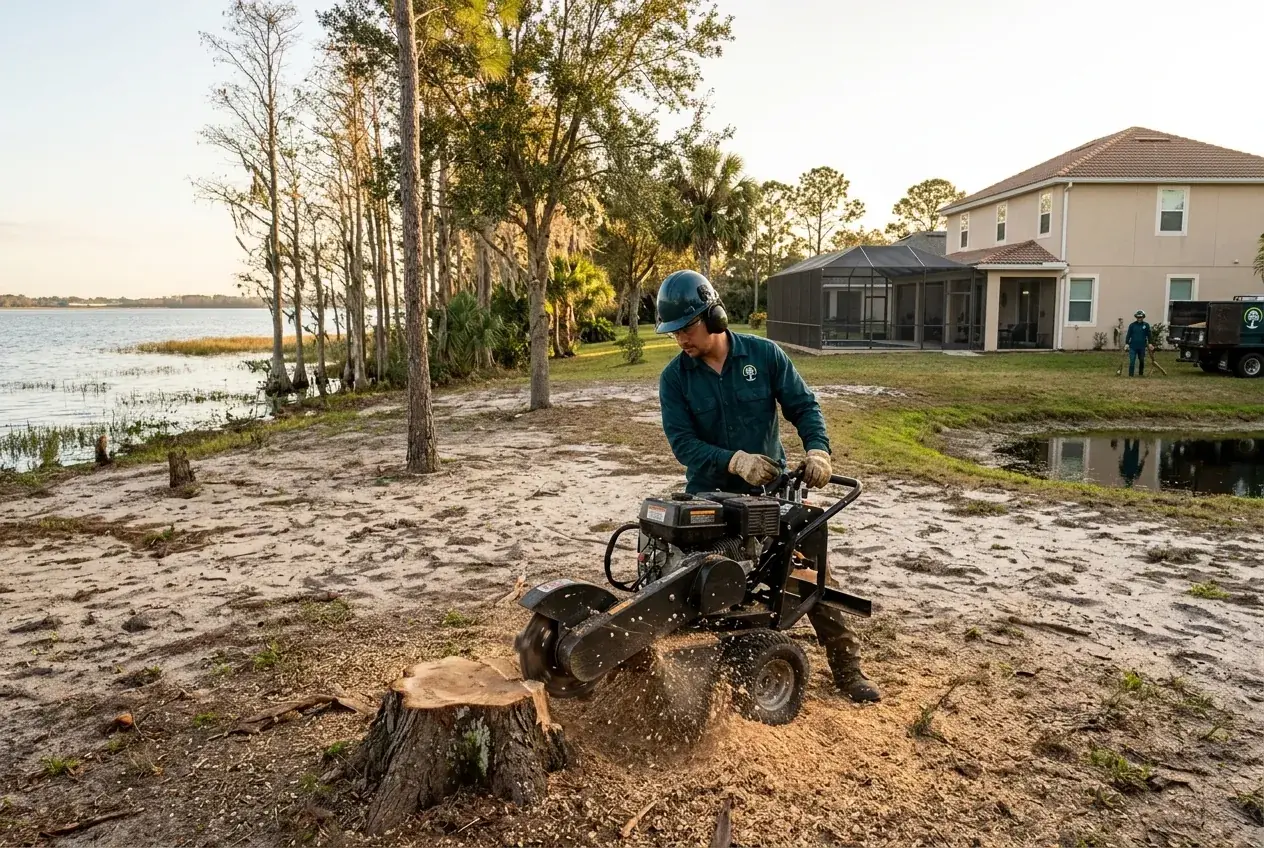
Downtown, the requests are mostly about old oaks: lifting limbs off roofs, thinning crowns so wind passes through and pulling deadwood before hurricane season. On lakefront lots it is often palm cleanup and clearing views to the water without stripping the shoreline. In the Canoe Creek area, homeowners call about laurel oaks splitting at the fork or roots heaving driveways. We also do a fair number of stump-grinding jobs where a previous owner cut a tree and left the stump.
St. Cloud Tree Removal Permits and City Rules
Inside city limits, the City of St. Cloud sets its own land development rules, which can include tree protection and replacement requirements for certain trees and projects. Lots just outside the line fall under Osceola County instead, so the first step is confirming whether your address is in the city. We could not confirm every current threshold in the city code, so we check it with the city on every estimate and tell you if an application is needed.
State law sets a floor everywhere. Under Florida Statute 163.045, the city cannot require a permit, fee or replacement tree for removing a tree on residential property when an ISA certified arborist or Florida licensed landscape architect documents that it poses an unacceptable risk. Newer neighborhoods such as Stevens Plantation or Twin Lakes may also have HOA rules, which apply separately.
St. Cloud Power Lines and OUC
St. Cloud's electric system is operated by the Orlando Utilities Commission under a long-standing interlocal agreement with the city, so most city addresses deal with OUC for line clearance. Some areas outside the city are served by Duke Energy. If a tree is resting on any wire, call the utility on your bill before calling us.
What Tree Service Costs in St. Cloud
Old downtown oaks push St. Cloud prices higher than the newer suburbs. A mature laurel oak over 60 feet that has to be climbed and lowered around a house and power lines often runs $1,900 to $3,800 or more. A medium tree in a Canoe Creek backyard usually lands in the $900 to $1,900 range. Thinning and deadwood removal on a big oak generally costs $200 to $950 depending on size and access. Stump grinding is typically $100 to $450 a stump, less per stump when there are several. If it is safe to wait a season, we will tell you.
St. Cloud Tree Services and Where to Start
Most St. Cloud homeowners start with tree trimming and pruning on an older oak, or full tree removal when a laurel oak is too far gone. We follow up with stump grinding so the yard can be replanted. Old oaks with a split fork can sometimes be saved with tree cabling and bracing. When storms hit, our emergency tree removal crew answers around the clock.
Tree Service Around St. Cloud
We cover the rest of eastern Osceola County too. North and east along CR 15, our Narcoossee tree service page covers the growing corridor along the east side of the lake. Farther out US-192, Harmony has its own HOA and conservation rules. To the west, Downtown Kissimmee sits on the bigger Lake Toho.
Questions
Questions About Tree Work in St. Cloud
Plenty of addresses with a St. Cloud mailing label are actually outside city limits. Your property tax bill or the Osceola County Property Appraiser site will show whether the parcel is in the city. That matters because city and county tree rules are separate. We confirm it before we quote any removal so you know whose rules apply.
Possibly, depending on the tree, the property and the work. The City of St. Cloud has its own land development regulations, and some removals may need review. If a certified arborist or licensed landscape architect documents that a residential tree is a danger, Florida Statute 163.045 removes the permit requirement. We check the current city rule on every estimate and help with any application.
Keep an eye on it. Oaks that stood in water for days after Ian can decline slowly over the next few years from root damage. Warning signs include thinning leaves at the top, dead branches, mushrooms at the base and bark coming loose. Some trees recover fully. We can look at it, tell you whether it is a risk to the house and give you an honest opinion on whether to wait.
Inside the city, the electric system is operated by OUC under an agreement with St. Cloud, so line clearance on main distribution lines goes through them. Outside city limits it may be Duke Energy. Never trim near a line yourself. Once the utility has cleared or de-energized the line, we can safely remove or prune the rest of the tree.
Laurel oaks were planted widely in older St. Cloud neighborhoods and in 1990s subdivisions because they grow fast. That speed comes with weak wood and a short life, often 50 to 70 years. Many are now at the age where decay sets in at the trunk and major forks. Live oaks are tougher and longer-lived, which is why we usually suggest them as replacements.
Yes. On East Lake Toho frontage we focus on view pruning, deadwood and palm cleanup, and we leave shoreline vegetation alone. Work below the normal high-water line or in wetlands can involve state rules from water management and wildlife agencies, so we keep our work on the upland side. If something near the water needs to come out, we tell you what approvals might be involved.
Most single stumps run $100 to $450 depending on diameter, root flare and access. A big old oak stump downtown costs more than a palm stump in a newer subdivision. Several stumps on one visit bring the per-stump price down. We grind below grade, rake out the chips and can haul them off if you want to sod or replant.
Yes. Our regular hours are Monday through Saturday, 7am to 7pm, which helps homeowners who work weekdays and want to be home when the crew is there. Emergency calls for trees on houses, cars or driveways go to our 24/7 line any day of the week.
Nearby
Other Osceola-Area Neighborhoods Near St. Cloud
Need a tree crew in St. Cloud?
We come out, look at the tree and put a fixed price in writing. St. Cloud is on our regular route.
Mon–Sat 7:00am–7:00pm (24/7 emergency line for storm work) · Licensed & insured