
Kissimmee · Osceola County, FL
Hurricane Tree Prep for Kissimmee Homes Before June 1
The cheapest storm damage is the kind that never happens. Before hurricane season, we walk your Kissimmee property, flag the trees most likely to fail, and prune or remove them the right way, without topping oaks or hurricane-cutting palms.
Hurricane Tree Prep Kissimmee Homes Need Before the Season Starts
Atlantic hurricane season runs from June 1 through November 30, and Osceola County has felt plenty of it. Charley tore across the county in 2004, Irma knocked down trees region-wide in 2017, Ian flooded neighborhoods along Shingle Creek in 2022, and Milton brought another round of downed trees in 2024. After every one of those storms, the same pattern shows up: the trees that fail are rarely a surprise. Dead pines, decayed oaks, heavy limbs over roofs, and trees standing in soaked ground near ponds go first.
Hurricane tree prep is about finding those trees while the weather is calm and the schedule is open. A spring visit costs a fraction of an emergency call in October, and the work can be done carefully instead of in a rush. It also avoids the scramble after a storm, when every crew in Central Florida is booked for weeks.
The walk-through itself is simple. We go tree by tree with you, look at the root flare, trunk, major unions and canopy, and note what each tree could hit if it failed. Each tree gets a plain rating: fine as is, prune this season, watch it, or remove it. You get that list in writing with photos, and you decide what to do now and what can wait a year. Plenty of trees end up in the fine-as-is column.
Hurricane Tree Prep in Kissimmee, FL: What It Includes
- A walk-through of every tree on the property, rating which ones could reach the house, pool cage, driveway or neighbors
- Removal of dead and dying trees, especially pines killed by lightning or beetles, before June 1
- Deadwood removal from oaks and other shade trees so loose limbs do not become projectiles
- Reduction pruning to shorten long, heavy limbs and lower weight at the ends of branches
- Structural pruning on young and mid-sized trees to correct weak forks before they become a problem
- Palm cleanup that removes dead fronds, seed stalks and loose material while leaving green fronds
- A written list of trees to watch, with photos, so you know what to look at after a storm
Pre-Hurricane Tree Pruning in Kissimmee the UF/IFAS Way
UF/IFAS research on trees after Florida hurricanes has shaped how we prune for wind. Well-structured trees with one dominant trunk and evenly spaced branches hold up far better than trees with competing stems and long, heavy limbs. Reduction cuts that shorten overextended branches back to a strong lateral, combined with removal of deadwood, lower the risk of breakage without stripping the tree.
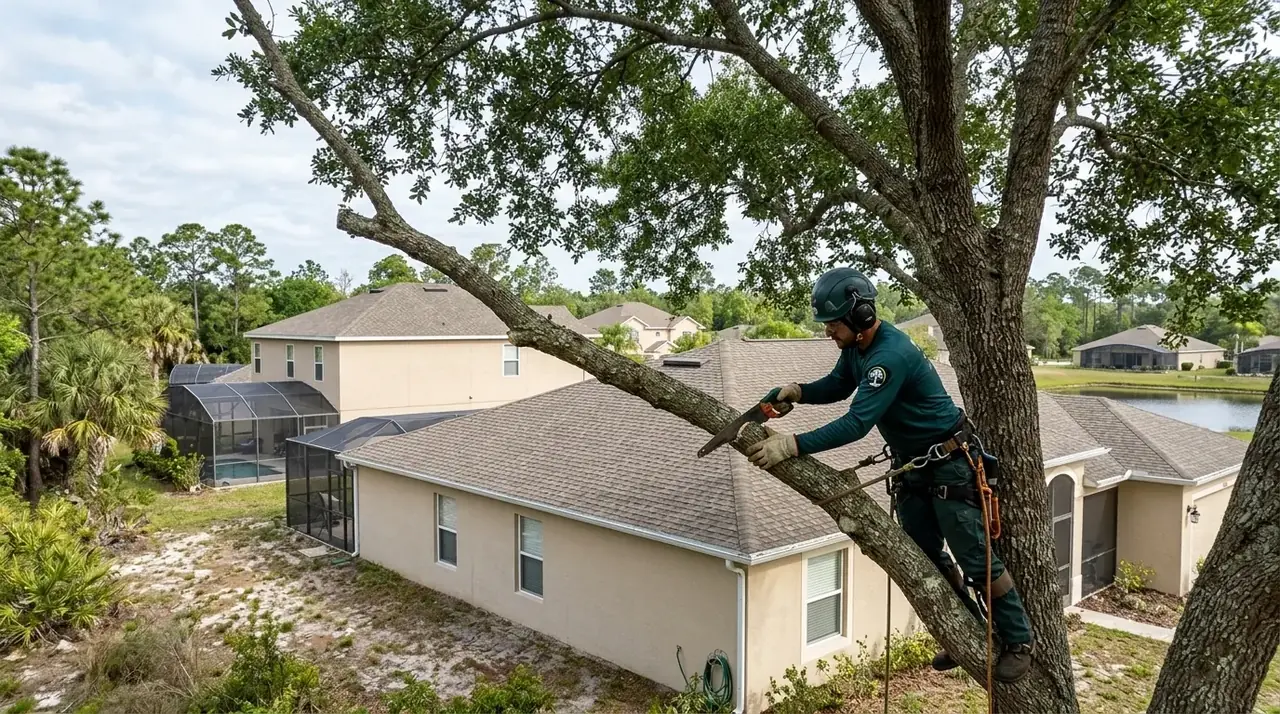
What does not work is just as important. Lion-tailing, stripping out the inner branches and leaving leaves only at the tips, pushes weight to the ends of limbs and makes them more likely to snap. Over-thinning a canopy can expose interior branches that are not used to wind. Topping, cutting big limbs back to stubs, leads to decay and a crown full of weakly attached sprouts that break easily in the next storm. For palms, the so-called hurricane cut, which strips a palm down to a few upright fronds, has the opposite of its intended effect: UF/IFAS extension reports note that heavily cut palms were more likely to lose their crowns in the 2004 and 2005 seasons. A palm should keep its green fronds. Our palm tree trimming page explains the right approach, and our post on why palms die in Central Florida covers the nutrient side of over-trimming.
Which Kissimmee trees we look at first
Species matters. In UF/IFAS hurricane surveys, live oak and sabal palm rank among the most wind-resistant trees in Florida, while laurel oak lost a large share of its branches in Hurricane Ivan and is often recommended for removal when over-mature. Water oaks behave similarly. Both are common in Kissimmee subdivisions, and older ones often hide decay at the base and in big unions. Pines are more mixed: a healthy slash or longleaf pine may ride out a storm, but a pine with a thin crown, lightning scars or beetle pitch tubes should come down before June. Brazilian pepper and camphor tend to grow in dense, brittle clumps and are worth clearing from around structures.
Hurricane Tree Prep Pricing for Osceola County Properties
Hurricane prep is priced like regular pruning and removal, tree by tree, and many owners prefer a single price for the whole property. Pruning usually runs $200 to $950 per tree, palms $90 to $300 each, and dead tree removal follows our standard size-based ranges.
| Job | Typical range | What moves the price |
|---|---|---|
| Storm-risk walk-through | Free with an estimate | Number of trees and size of the lot |
| Pre-storm pruning per tree | $200–$950 | Canopy size, limbs over the roof, deadwood amount |
| Palm cleanup per palm | $90–$300 | Height and amount of dead fronds and seed stalks |
| Dead pine or small tree removal | $350–$1,900 | Height, lean, and what sits below it |
| Cabling a weak fork | $350–$1,200 | Number of cables or rods needed |
| Whole-property storm prep | Quoted per property | Tree count and mix of pruning and removal |
Hurricane Tree Risk on Kissimmee's Flat, Wet Ground
Around Kissimmee, roots matter as much as branches. The land is flat pine flatwoods with sandy soil and a water table that rises close to the surface in the summer wet season. Many trees root shallowly as a result, and when a hurricane drops heavy rain on already wet ground, whole trees tip over with a disk of roots and sand. Ian showed this clearly in 2022, when historic rainfall overwhelmed drainage in northern Osceola County. Trees beside retention ponds, canals, ditches and lakes, trees whose roots were cut for driveways, irrigation or utilities, and trees that already lean are the ones we watch most. Our post on what Ian taught Osceola County about trees covers that storm in more detail.
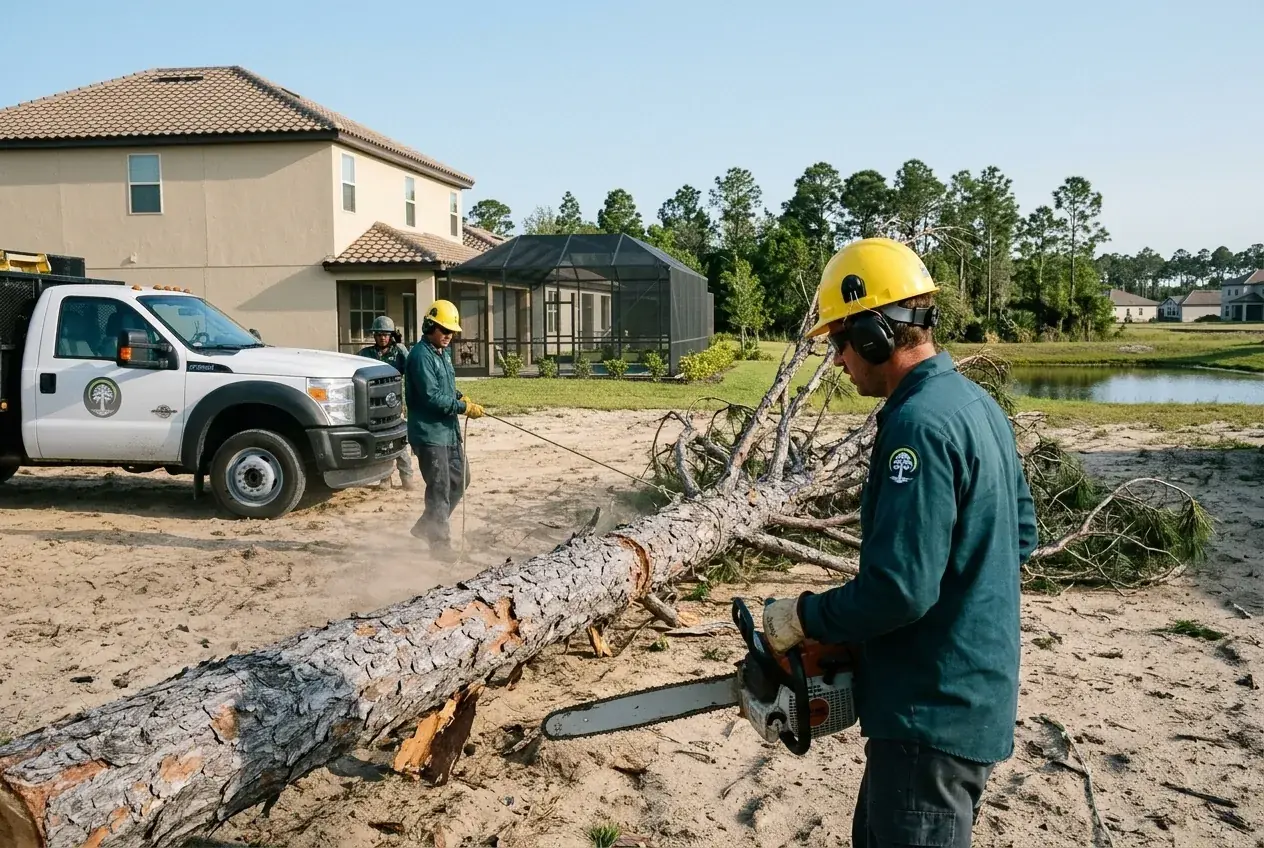
Pruning cannot fix a bad root plate. If a large tree near the house has lost roots on one side, has a cavity at the base, or has started leaning more over the past year, removal is usually the right answer, done through our regular tree removal service before the season. For a valued oak with one weak fork and healthy roots, cabling and bracing may be the better fit.
If a tree does come out, think about what replaces it. A live oak or southern magnolia planted well away from the house, or a cluster of sabal palms near the pool, will stand up to future storms far better than another laurel oak or a fast-growing exotic. Give new trees room to spread their roots, keep them out of the low spots that hold water, and they will be the storm-resistant canopy of the next twenty years.
Hurricane Tree Work to Avoid in the 72 Hours Before a Storm
Once a storm is in the forecast, it is too late for most tree work. Cutting limbs and piling them at the curb in the last few days before landfall creates debris that pickup crews cannot collect in time, and loose piles can blow into homes and cars. Counties and cities in Central Florida routinely ask residents not to put out new yard waste right before a storm. Our crews also stop climbing once sustained winds pick up, for obvious reasons. Use that window to secure patio furniture, grills, pool equipment and anything else that can fly, check that gutters and drains are clear, and photograph your trees for insurance.
After the storm, Osceola County and the City of Kissimmee have asked residents in recent years to keep vegetation separate from construction debris and to place piles near the road without blocking it. Rules change with each event, so watch for official announcements. When cleanup is needed, our storm damage cleanup crews take over.
Hurricane Tree Prep Across Kissimmee and Nearby Communities
Most pre-storm visits are booked between January and May, and a typical property is pruned in a single day. We prep trees throughout Downtown Kissimmee, in Meadow Woods and Hunters Creek to the north, and on the newer streets of Harmony. Rental owners who cannot be on site can add a report to the visit through our vacation rental tree service. Ask for a storm-risk walk-through through our online estimate form.
Questions
Hurricane Tree Prep FAQ for Kissimmee Property Owners
The best window is from winter through May, before the season officially starts on June 1. Pruning then gives trees time to respond before peak storm months, and crews have open schedules. Light deadwood removal can be done any time, but avoid heavy pruning in late summer and never wait until a storm is already in the forecast.
Some thinning helps, but more is not better. UF/IFAS work supports removing deadwood, shortening heavy limbs and correcting weak structure. Stripping out the inner branches, called lion-tailing, or removing too much of the canopy can make limbs more likely to break. We aim for a balanced canopy with weight reduced at the ends of long branches, not a hollowed-out tree.
No. Cutting a palm down to a few upright fronds weakens it. UF/IFAS extension reports found heavily cut palms were more likely to lose their crowns in strong hurricanes, and removing green fronds also robs the palm of stored nutrients like potassium. Before the season, remove dead fronds, seed stalks and loose material, and leave the healthy green fronds in place.
In UF/IFAS hurricane surveys, laurel oaks lost a large share of branches and are often recommended for removal when over-mature, and water oaks behave similarly. Dead or declining pines, trees with decay at the base, and trees with weak forks are also high risk. Live oaks and sabal palms rank among the most wind-resistant. Location matters too: trees near ponds and in saturated soil are more likely to uproot.
It is better not to. Debris piles placed at the curb in the final days before a storm usually cannot be collected in time, and loose branches can become projectiles. Local governments often ask residents not to put out new yard waste right before a storm. Use those days to secure outdoor items, and schedule tree work early in the season instead.
Much of the county is flat pine flatwoods with sandy soil and a high water table. Trees root shallowly, and when a slow hurricane adds heavy rain on top of the summer wet season, the soil can no longer hold them. The tree tips with a wide, shallow root plate. Trees near retention ponds, lakes and ditches, or with roots cut by construction, are especially vulnerable.
Pre-storm work is priced like regular pruning and removal. Pruning usually costs $200 to $950 per tree, palm cleanup $90 to $300 per palm, and dead tree removal follows our standard size-based ranges. Many owners prefer one price for the whole property, which we provide after the walk-through. The storm-risk assessment itself comes free with the estimate.
Yes, if it could reach your home, a neighbor's home, a driveway or a power line. Dead trees, especially pines, become brittle quickly and are among the first to fail in a storm. Removing one in spring costs regular rates. Waiting until it falls on something means emergency pricing, possible insurance claims, and a long wait for a crew after a storm.
Good pruning lowers the chance of limbs breaking, but it cannot prevent a tree from uprooting if its roots are weak or the soil is saturated. That is why our walk-through checks the root zone, lean, soil and nearby water as well as the canopy. If a tree has serious root or trunk problems, we will recommend removal rather than pruning.
Many associations allow routine pruning without approval but require a request before a tree is removed. Rules vary by community, so check your HOA guidelines. If approval is needed, we provide photos, the tree species and size, and a short description of the work. For hazardous trees, Florida Statute 163.045 limits local government permit requirements, though HOA rules may still apply.
Related
More Tree Services Around Kissimmee
Get ahead of the next storm
Book pre-season pruning and dead-tree removal before June, not after the warning.
Mon–Sat 7:00am–7:00pm (24/7 emergency line for storm work) · Licensed & insured