
Why Palm Trees Die in Central Florida: Start With the Symptoms
Palms do not decline the way oaks do. They grow from a single bud at the top, called the spear, and they cannot replace it. If that bud dies, the palm dies, no matter how green the older fronds still look. So the most important question for any sick palm is whether the spear leaf is still firm and healthy.
Beyond that, where the symptoms show up tells you a lot. Problems on the oldest, lowest fronds often point to nutrition. Problems in the spear or the whole canopy at once point to disease or root failure. A shelf-like growth on the trunk is a specific and serious sign. The sections below walk through each cause.
Ganoderma Butt Rot in Kissimmee Palms
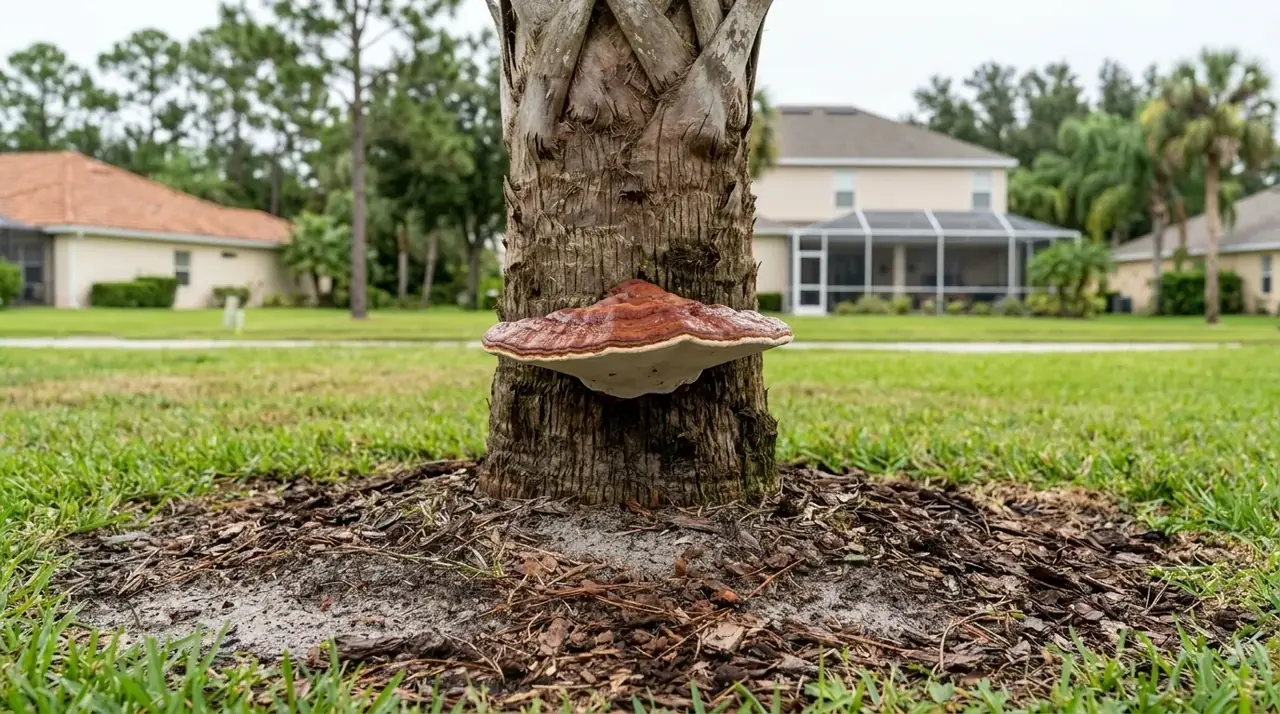
Ganoderma butt rot, caused by the fungus Ganoderma zonatum, rots the lower four to five feet of the trunk from the inside. UF/IFAS considers all palms susceptible and has documented it in at least 65 species. The tell-tale sign is a conk, a hard, shelf-like growth that is reddish-brown on top and white underneath, attached right to the trunk. Many palms die before a conk ever appears, so the absence of one does not clear a palm that is wilting.
There is no known chemical or cultural cure. Because the inside of the trunk is rotting, infected palms are prone to falling, so UF/IFAS recommends prompt removal once conks show up. The fungus survives in stumps and soil, which is why stump grinding and removing as much of the root mass as practical matter. UF/IFAS also cautions against planting another palm in the same spot, since replacements there have died too. Non-palm plants are not affected, so a shade tree or shrub is a safer replacement.
Lethal Bronzing Disease in Osceola County Palms
Lethal bronzing is caused by a phytoplasma, a type of bacterium that lives in the palm's sap. It is spread by a small sap-feeding insect, the palm cixiid (Haplaxius crudus), whose young develop in turfgrass. It was first found in Florida in 2006 in Hillsborough County and has since spread to dozens of counties. Sabal palms, Florida's state tree, are a major host, along with Canary Island date palms and other species.
The first sign is often fruit dropping early. Then the oldest fronds turn a bronze or reddish-brown and the discoloration climbs the canopy until the spear collapses. Once that happens, the palm is lost. UF/IFAS recommends removing symptomatic palms right away. Preventive trunk injections of oxytetracycline every three to four months can protect healthy, uninfected palms nearby, but they will not cure a palm that already shows symptoms.
Fusarium Wilt on Canary Island Date and Queen Palms
Fusarium wilt is a fungal disease that clogs the water-conducting tissue in the trunk and fronds. Two forms matter here. One mainly attacks Canary Island date palms. The other, Fusarium oxysporum f. sp. palmarum, mainly attacks queen palms and Mexican fan palms, which are very common around Kissimmee homes and rentals.
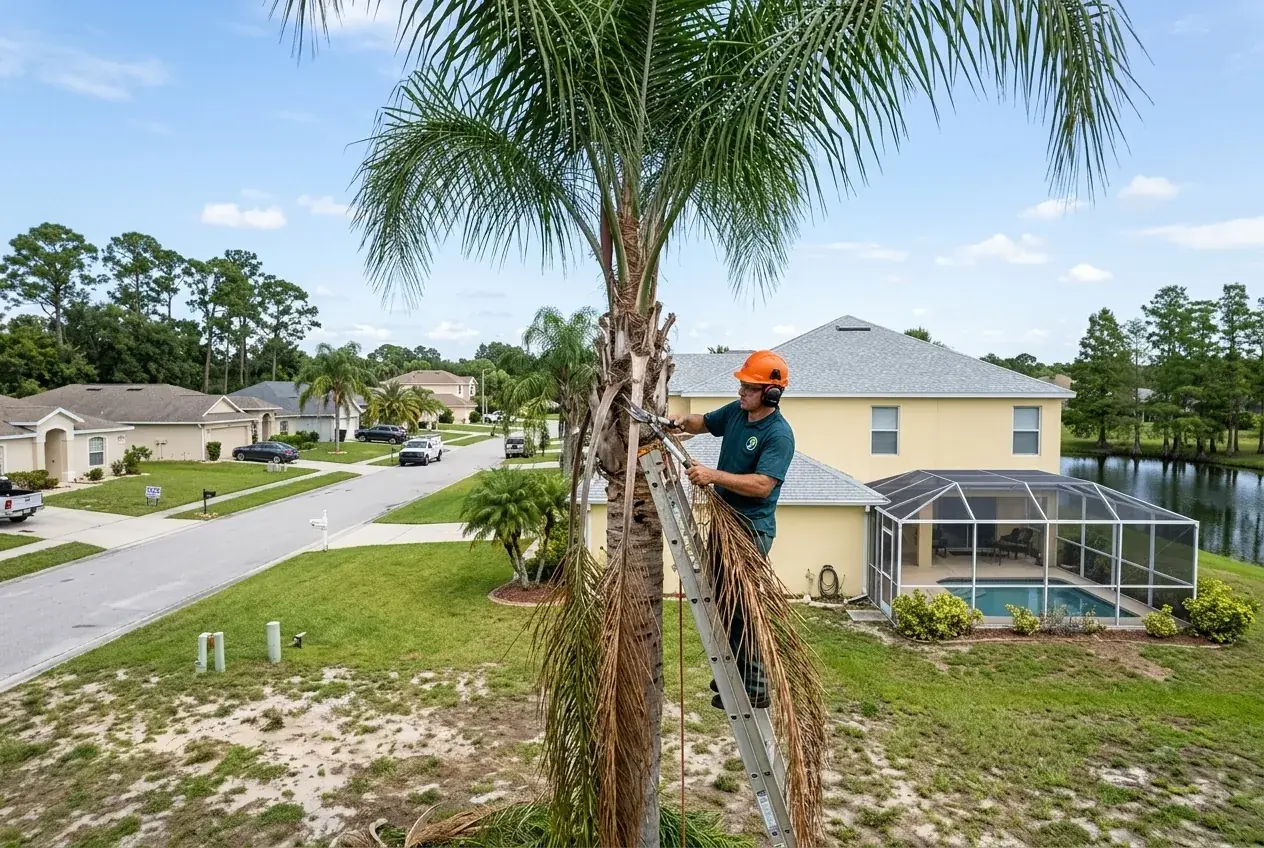
The classic symptom is one-sided: leaflets turn yellow and brown on one side of the frond first, often with a reddish-brown stripe along the stem. It starts on the oldest fronds and moves up. UF/IFAS says there is no cure and that affected palms often die within a few months. Contaminated pruning tools can spread it, which is a real reason to hire a crew that disinfects saws between palms. We do that on every palm tree trimming job.
| Cause | What you usually see first |
|---|---|
| Ganoderma butt rot | Wilting canopy, then a shelf-like conk on the lower trunk |
| Lethal bronzing | Early fruit drop, then bronze fronds moving up to the spear |
| Fusarium wilt | One side of the oldest fronds browning, with a stripe on the stem |
| Potassium deficiency | Yellow-orange spotting on the oldest fronds; frizzled new leaves when severe |
| Cold damage | Browned fronds after a freeze; check whether the spear pulls loose |
| Transplant shock | Slow decline in the first year after planting |
Potassium Deficiency and Over-Trimming in Kissimmee Palms
Not every sick palm has a disease. Potassium deficiency is extremely common in Florida's sandy soils. It shows up first as translucent yellow-orange spotting or dead tips on the oldest fronds. Because potassium moves inside the palm, the tree pulls it out of old fronds to feed new growth. That is why the oldest leaves look worst.
Here is where trimming goes wrong. When those spotted older fronds are cut off, the palm starts pulling potassium from the next fronds up, which were still green. UF/IFAS research has shown that repeated pruning of deficient fronds reduces the number of healthy leaves and, in severe cases, speeds the palm's decline. The so-called hurricane cut, which strips a palm down to a few upright fronds, makes it worse. The fix is a proper palm fertilizer with slow-release potassium and magnesium, and patience, since damaged fronds never recover and it takes new growth to restore the canopy.
Palm Fertilizer Basics for Kissimmee Yards
UF/IFAS research points to an 8-2-12-4 palm fertilizer, or 8-0-12-4, with micronutrients, as the target analysis. The label matters as much as the numbers. UF/IFAS says the most effective products have all of the nitrogen, potassium, magnesium and boron in slow-release or controlled-release form, because soluble potassium washes through our sand quickly. A cheap bag with the right numbers but fast-release ingredients will not fix a deficient palm. Some Florida cities and counties also restrict nitrogen and phosphorus fertilizer during the summer rainy season, so check local rules before you spread anything.
Cold Damage to Palms in Central Florida
Freezes occasionally reach Osceola County, and tropical palms like queen palms show it first. Damage often looks worse in the days after a cold night than it really is. UF/IFAS extension advice is to wait before judging, and to leave any frond with green tissue on the palm until new growth appears. The key test is the spear leaf. If it is firm, the palm will probably recover. If it pulls out easily, the bud may be rotting, and extension agents suggest removing the dead spear and treating the bud area with a copper fungicide, while noting there is no research proving how well that works.
Transplant Shock in Newly Planted Palms
New palms in subdivisions around Harmony and St. Cloud often decline in their first year. With sabal palms, UF/IFAS explains that cut roots do not branch and regrow. They die back and get replaced by new roots from the base of the trunk, so the palm lives off stored water for months. Broschat's research found that removing all leaves at digging raised sabal palm survival to 95 percent, compared with 64 percent for palms moved with a third of their leaves. Steady irrigation during establishment matters as much as anything.
When to Remove a Dying Palm in Kissimmee
A palm with a confirmed Ganoderma conk, lethal bronzing or Fusarium wilt should come out promptly, both for safety and to reduce spread. A palm with a dead spear is not coming back. Palms with nutrient problems or mild cold damage are usually worth saving. If you are not sure, we can look at it and tell you which group it is in. Our tree removal crews take palms down in sections when they are near a pool or roof, and in Celebration and other HOA communities we can provide photos for an approval request. Owners of rental homes may also find our vacation rental tree care guide useful.