
Does Spanish Moss Hurt Trees? The Short Answer Is No
Spanish moss (Tillandsia usneoides) is not a moss and not a parasite. It is a bromeliad, a relative of the pineapple, and it is an epiphyte, meaning it grows on other plants only for support. It has no roots that tap into the tree. UF/IFAS explains that it takes in water and nutrients through tiny scales on its surface, from the air, from rain and from debris that washes down the branches. It is not stealing anything from your oak.
That separates it from mistletoe, which is a true parasite and does pull water and nutrients from its host. If you see a clump of green, leafy growth with its own branches rooted into an oak limb, that is a different conversation.
Ball Moss on Kissimmee Oaks Works the Same Way
Ball moss (Tillandsia recurvata) is the small, round, gray tuft you see on twigs, fences and even power lines. It is a close cousin of Spanish moss and also an epiphyte. UF/IFAS groups Spanish moss, ball moss and lichens together as harmless epiphytes. Ball moss often seems to take over the inner, shaded twigs of a tree, which leads people to think it killed them. In most cases those twigs were already dying from lack of light.
When Heavy Spanish Moss Is a Symptom of a Declining Tree
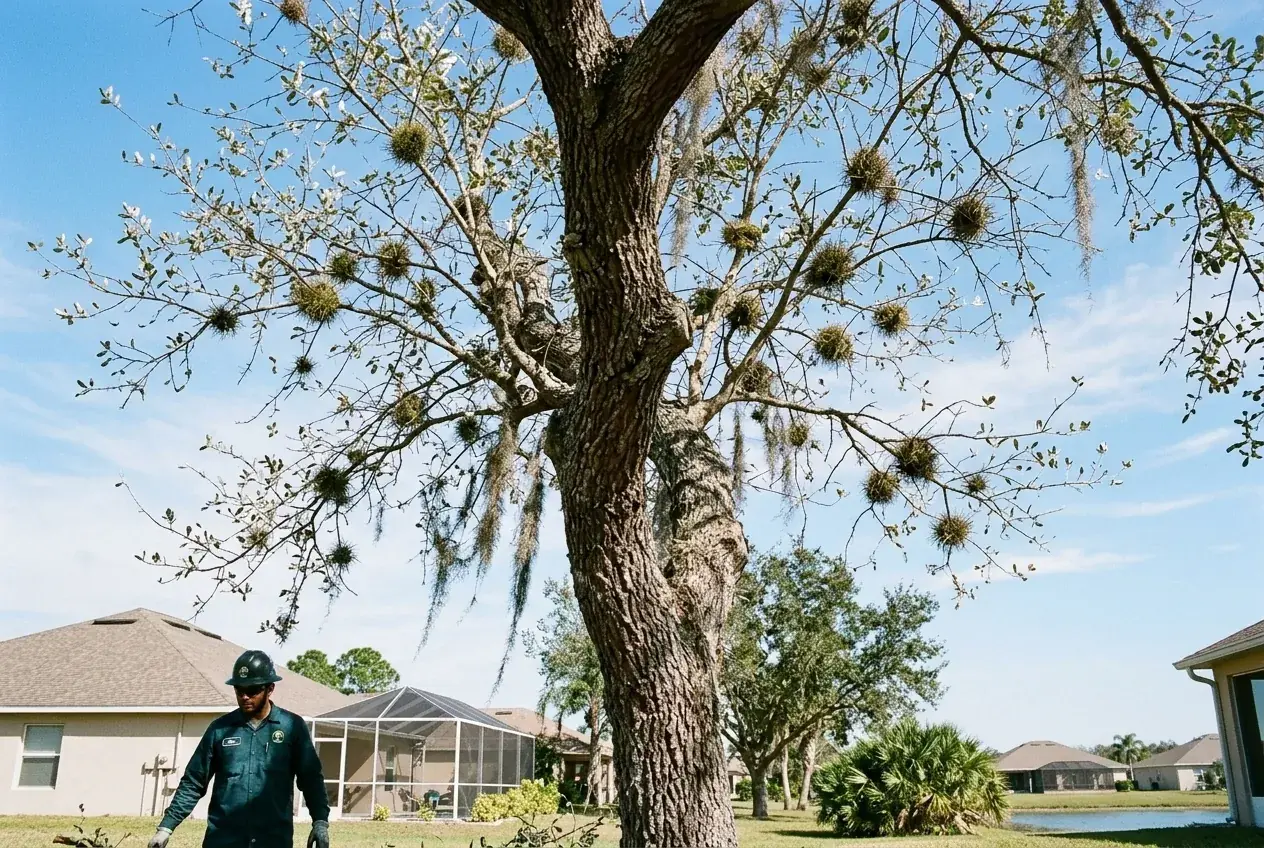
Here is the part that matters for homeowners. Both Spanish moss and ball moss prefer high light. A healthy, dense canopy shades its own interior, which limits how much moss can grow. When a tree starts losing leaves, more light reaches the branches and moss fills in. UF/IFAS notes that moss thriving on a weak or dead tree does not make it the cause of the decline. It is a signal that something else is going on.
The same goes for lichens, the flat gray-green crusts on bark. UF/IFAS says heavy lichen growth can point to a stressed plant, because thin, defoliated branches let in the sunlight lichens need. If your oak's moss load has jumped in a year or two, look at the tree itself:
- Is the canopy thinner than it was, with more sky showing through?
- Are there dead branch tips at the top or outer edge of the crown?
- Has anything changed in the root zone, such as a new driveway, pool, irrigation trench or fill dirt?
- Has drainage changed, leaving water standing where it did not before?
- Are there mushrooms, cavities or oozing at the base of the trunk?
UF/IFAS lists soil compaction, changes in drainage and disease among the more common reasons trees decline. Those are the real problems to solve, and removing the moss will not fix any of them.
| Myth | What UF/IFAS research says |
|---|---|
| Spanish moss is a parasite | It is an epiphyte that takes water and nutrients from the air and rain |
| Moss killed my oak | Moss thrives on trees already losing leaves, but does not cause the decline |
| Moss weight breaks healthy limbs | Breaks usually trace to existing weakness; the moss weight itself is small |
| Moss in trees is full of chiggers | Chiggers are found in moss lying on the ground, rarely in moss up in trees |
| You should strip all moss off | Removal is costly, usually unnecessary, and the moss tends to grow back |
Spanish Moss and Chiggers: Separating Myth From Fact
The chigger story has some truth to it, just not the way most people tell it. Chiggers live mostly in low, damp vegetation near the ground. UF/IFAS says moss that has fallen and is lying on the ground can harbor them, but moss hanging in a tree rarely does. If you are gathering fallen moss for a craft project or cleaning it out of a flower bed, wear gloves and long sleeves. Moss still hanging in the canopy is not a reason to worry.
Should You Remove Spanish Moss From Trees in Kissimmee?
Usually not, and UF/IFAS specifically encourages leaving it. Spanish moss is shelter for wildlife. Two bat species use it as daytime roosts, zebra longwing butterflies sleep in it, and birds such as the northern parula use it as nesting material. It also tends to grow back after removal, so it is rarely money well spent.
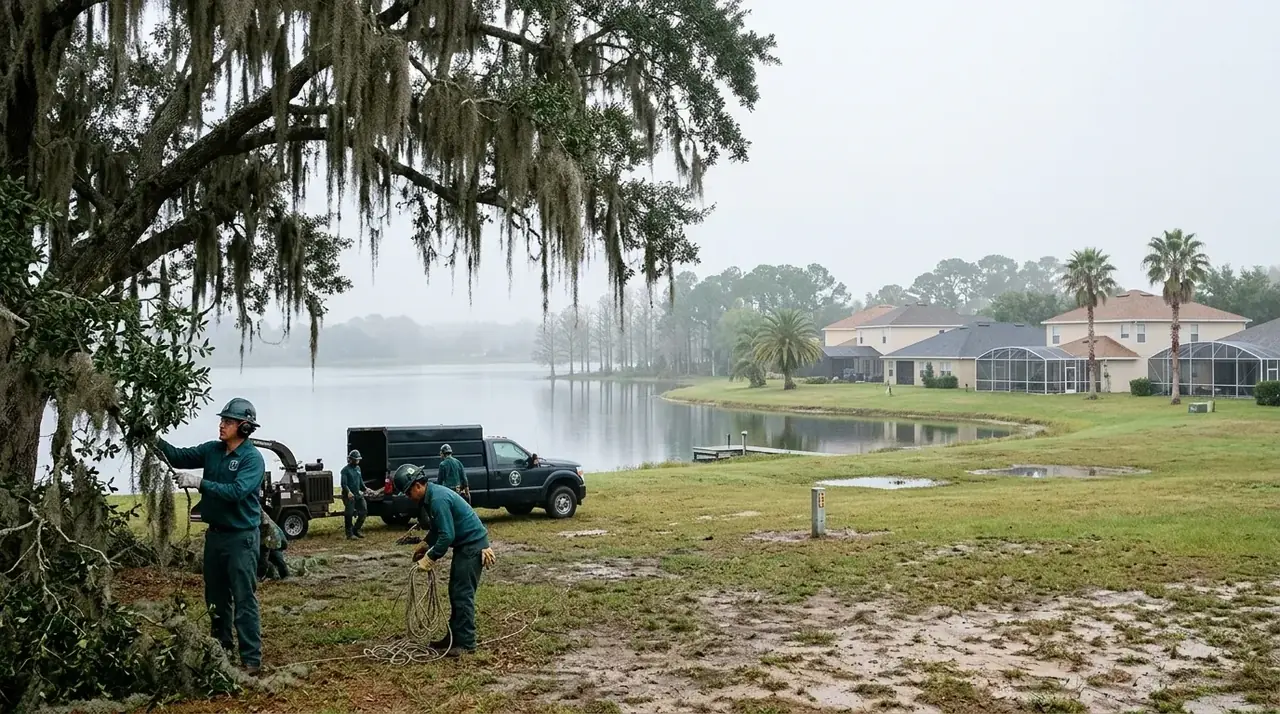
There are a few cases where removal makes sense, such as thick moss hiding a crack or cavity we need to see, or moss hanging into a gutter or over a doorway. Hand removal works on small trees. Large oaks need a lift and a careful crew. UF/IFAS warns that copper-based sprays labeled for moss can damage tender new growth on oaks, can drift onto neighbors' plants, and leave dead gray moss that still has to come down. We do not recommend spraying.
How Spanish Moss Grows and Spreads in Central Florida
Spanish moss is a flowering plant. It produces small, greenish, fragrant flowers, usually in spring around April, though most people never notice them. It is also very drought tolerant. In a dry spell the strands turn gray and go dormant, and after a good rain they green up again. That is why the same oak can look silver one week and soft green the next.
UF/IFAS notes that it grows on live oaks, cypress, crape myrtles, pines and sweetgums, and also on fences and telephone poles. That last detail is the clearest proof that it does not feed on its host. A fence post gives it nothing but a place to hang. People also used it for generations as stuffing for mattresses, car seats and furniture, and as insulation, which tells you how much of it has always grown here.
Spanish Moss Near Lake Toho and Other Wet Spots
UF/IFAS notes that epiphytes grow best in well-lit, humid places, especially near rivers, ponds and lakes. That is why oaks and cypress along Lake Toho in Downtown Kissimmee, and around the lakes near Narcoossee and St. Cloud, are often covered. Heavy moss on a waterfront tree is normal. Heavy moss on a tree that used to have very little is the pattern worth checking.
What a Tree Health Check Looks At
When we look at a mossy oak, the moss is the last thing on the list. We check the trunk flare for decay and fungus, look for cracks and weak branch unions, compare the leaf density with what a healthy tree of that species should have, and ask about recent work in the root zone. On flat, wet lots we also look at how water moves across the yard, since a new patio or a re-graded side yard can leave roots sitting in water for weeks during the rainy season.
Kissimmee Tree Health Signs That Matter More Than Moss
If an oak really is declining, the decision is about safety and timing. A tree with a few dead limbs can often be pruned and kept. A large laurel or water oak with decay at the base, close to the house, may be a removal candidate, especially ahead of storm season. A valuable live oak with a weak fork might be a candidate for tree cabling and bracing. And if a pool or driveway project cut through its roots, our article on tree roots, pool decks and foundations explains what that damage can mean.